

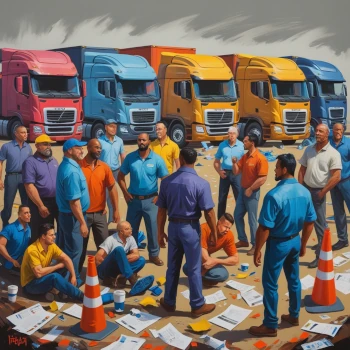
I have already written about the solidarity among truck drivers. Actually, I should have reposted that article, but somehow I missed it. Well then, here is the new version of the post.
One can repeatedly read in social media that drivers complain about the lack of cohesion within their profession.
However, they themselves are hardly doing anything to foster this missing cohesion again.
Of course, there are transport sectors where such solidarity exists. For example, in roundwood transport. There, the motto is: “In the forest, we help each other, and the forest belongs to us all.” Of course, there are also some exceptional individuals here and there; that’s no question. This help is based on reciprocity and should be understandable in this form. To put it more clearly: If I help you, then you should also help me when I’m in a tough spot.
This works for us, so why not in other transport sectors as well?
In my old post, I wrote that I have always handled things such that if another driver had a problem—whether on the road, at a rest stop, or at the central depot—I would help them. I do not expect direct compensation for this. Only perhaps some help in return when I need it myself.
But back to social media. There, one can clearly see that very few have a real interest in fostering solidarity among drivers.
Most recently, I could see this again under a post about night shifts and their health consequences: the comments were far from grateful.
Rather than support, there was mostly mockery and contempt. Not infrequently, one read the phrase: “If you can’t handle it, then you’re in the wrong profession.”
It’s not about whether someone is unsuited for the profession. The fact that our job, due to its irregularities determined by the routes, does not exactly contribute to us staying fit into old age, is often ignored.
But such reactions show that solidarity among drivers is not desired. People simply do not wish others the “butter on their bread” just because we both transported goods from A to B.
In any case: Stop complaining that there is no longer solidarity among drivers. You don’t want it. And yet, through this very solidarity, much could be improved for us drivers in general. Because that’s where we are needed—not others, not the associations and initiatives that almost weekly set up new ones, believing they need to reinvent the wheel to improve everything in the industry. So far, very few have achieved anything at all.