

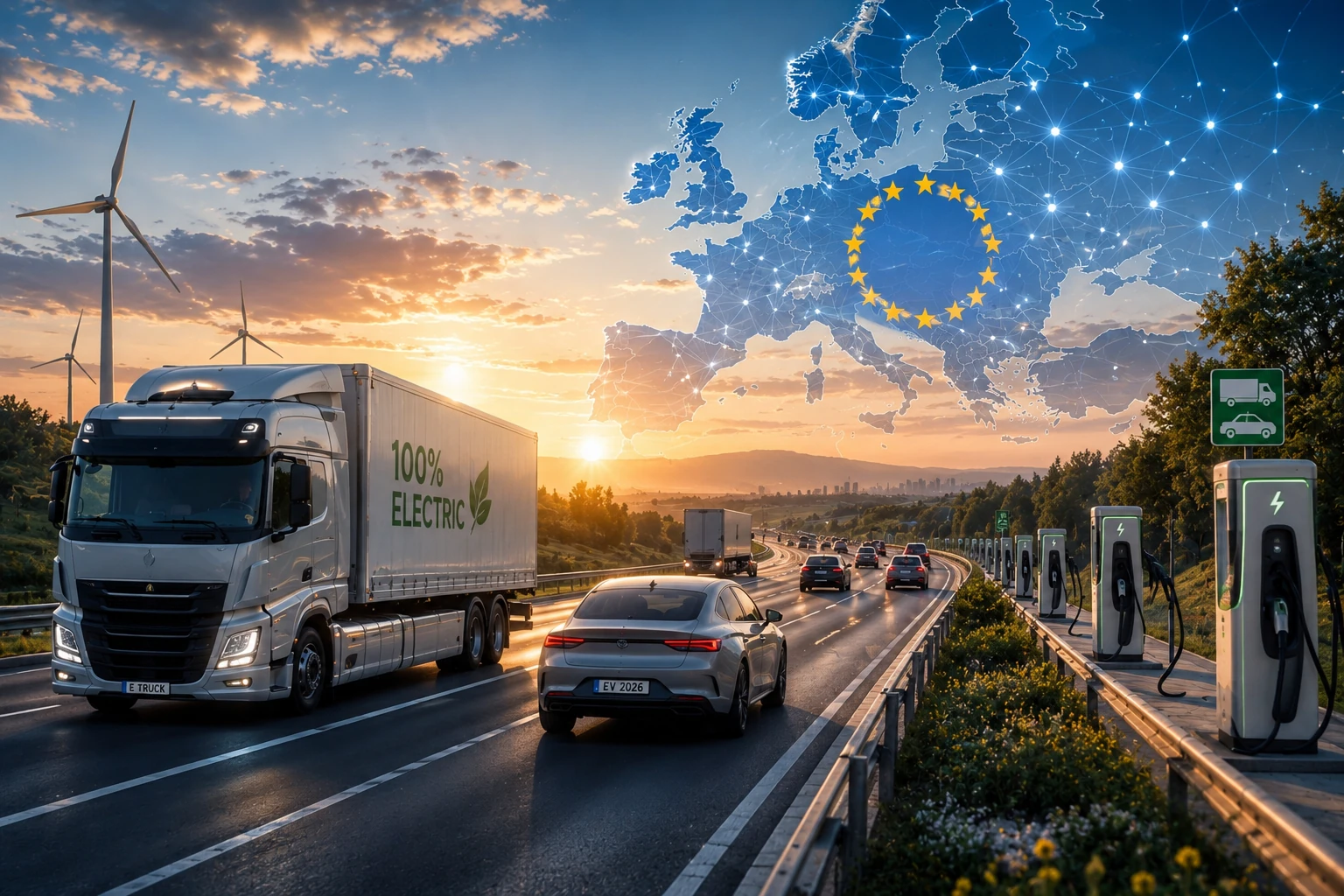
Recently, I received a comment under a post about my European Charging Station Card , roughly saying:
“Nobody needs one… hopefully.”
Such statements are frequently encountered when it comes to electric mobility. Often accompanied by the notion that the topic is merely a short-lived trend or will not gain traction anyway.
However, looking at the current figures in Europe reveals quite a different picture.
Just in April, around 200,000 new battery-electric vehicles (BEVs) were registered across Europe. This corresponds to growth of nearly 40 percent compared to the previous year’s period. At the same time, the market share of fully electric vehicles across Europe has now exceeded 20 percent of all new registrations. In other words:
More than one in five newly registered cars is now running purely on electricity.
And this growth concerns far more than just a few showcase countries.
Germany, France, Italy, Spain, and Poland are reporting partly strong increases in registrations. Particularly interesting here: Even countries that were previously rather hesitant when it comes to expansion are now making noticeable progress.
Of course, this does not mean that tomorrow suddenly all internal combustion engine vehicles will disappear. But the direction is now quite clear:
Electric mobility is growing — and across Europe.
With this growth, a second question automatically arises:
Where do these vehicles actually charge?
Because the more electric cars are on the road, the more relevant charging infrastructure becomes. Not at some point in the distant future, but already today.
And exactly here one quickly realizes that reality is more complicated than many discussions in social networks might suggest.
Anyone traveling cross-border, driving long distances, or working professionally in the transport sector will quickly notice: charging points, operators, expansion speed, and regional differences suddenly play a role.
The topic becomes particularly interesting when it comes to heavy-duty transport.
While some are still discussing whether electric trucks will come at all, manufacturers and operators are already investing billions in corresponding infrastructure. New charging hubs are being established along important traffic axes, existing locations are being expanded, and across Europe work is underway on building powerful fast-charging points.
One does not have to like electric mobility. One also does not have to drive an electric car.
But pretending that the topic is irrelevant or will disappear again simply does not do justice to current developments.
Perhaps indeed not every person needs a card with charging infrastructure in Europe.
But if every month hundreds of thousands of new electric vehicles are added, then there is good reason to believe that the need for an overview is becoming larger rather than smaller.
