

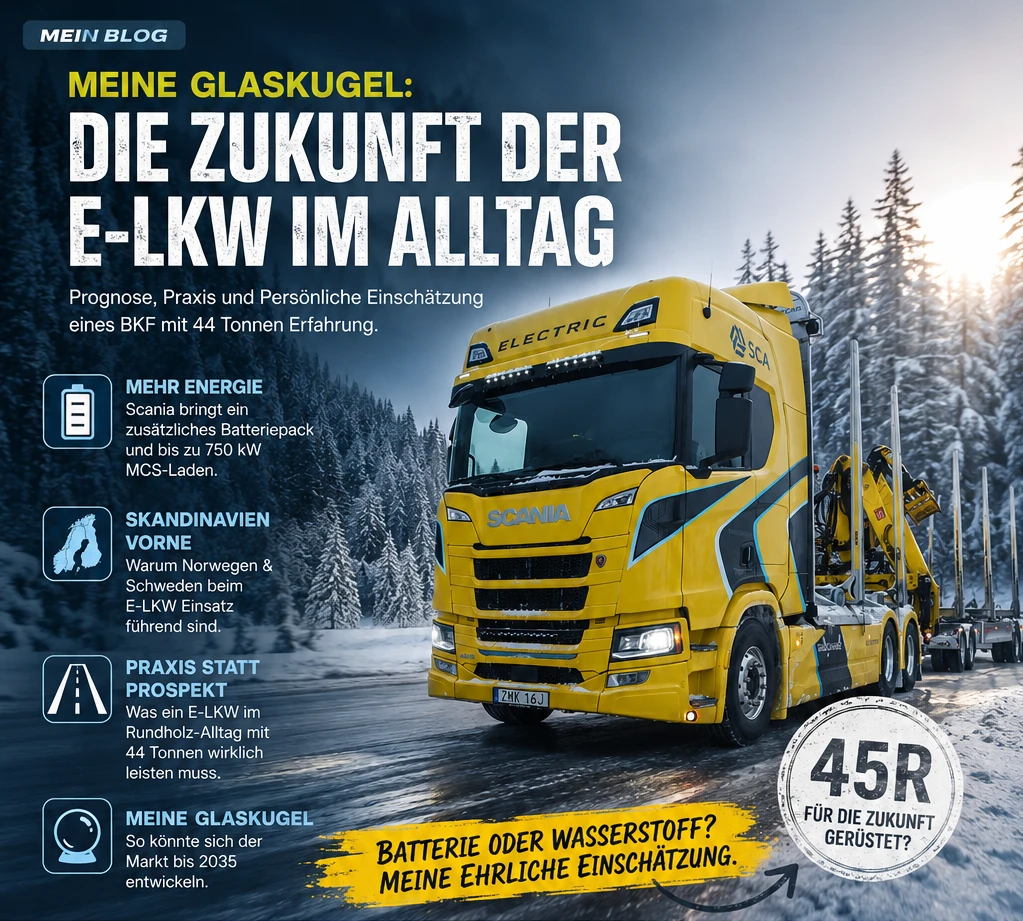
My Crystal Ball for the Future of E-Trucks: Why Batteries Will Conquer Daily Operations – But Not Everywhere
Comment / Opinion
When talking about the future of trucks today, sooner or later one inevitably arrives at a matter of faith: battery or hydrogen?
And to be honest: A few years ago, I would have said myself: “In heavy-duty vehicles? That can only be hydrogen.”
Today, I see things much more differently.
Not because I suddenly believe every manufacturer brochure. But because something is changing in everyday practice. And because technology is making progress faster than many – including myself – expected just a few years ago.
From “Never Possible” to Everyday Use
Not too long ago, an electric truck was still considered by many to be nothing more than a nice trade fair gimmick.
Too heavy. Too little range. Too long charging times. Useless in winter.
Today, heavy-duty electric trucks are already in regular operation – especially where routes are predictable. Construction site logistics, distribution traffic, port operations, or fixed routes between plants.
And even in long-haul transport, development is moving faster than many believe.
What I find particularly exciting is the development at Scania.
Scania Shows Where We Are Heading
Scania has recently further developed its electric trucks. New features include, among others, an additional battery pack under the driver’s cab. This allows for greater energy reserves – while simultaneously maintaining more flexibility in vehicle construction.
Even more interesting: The new Megawatt Charging System connector (MCS) is designed to enable charging powers of up to 750 kW. Put simply: significantly faster charging than before. That could become one of the decisive levers.
Because the real problem is not always range – but time.
If a truck can be sensibly recharged during its legally mandated break, that completely changes the discussion.
Scania now speaks – depending on the application profile – of significantly higher ranges. In some configurations, even ranges beyond 800 kilometers. However, one must remain fair: This likely applies more to optimized long-haul profiles and not to heavy specialized transports in hilly terrain.
For heavy combinations, Scania itself cites much more conservative figures. At a gross weight of 64 tonnes, the manufacturer currently speaks of around 330 kilometers of range, with correspondingly higher values for lighter configurations.
And Scandinavia? They Are Already Far Ahead
Interesting is also the look northward.
Those who speak with workshops or drivers always hear: In Scandinavia, significantly more electric trucks are in operation than here.
And that seems plausible.
Norway and Sweden are now considered pioneers in the electrification of commercial vehicles. Massive investments are being made in charging infrastructure – including fast-charging and megawatt charging technology. At the same time, these countries benefit from a cheaper electricity mix and clearer political frameworks.
In short: In those countries, electric trucks are not just shown at trade fairs – they are already driving in everyday life.
But Now Comes Practice
And it is exactly here that things become interesting.
Because there can sometimes be worlds between a brochure and a working day.
I drive roundwood myself. With approval, I have been operating with 44 tonnes gross weight for several years now.
And precisely because of that, I look at the development perhaps somewhat more skeptically – but also from a practical perspective.
Because roundwood is not simple long-haul transport on the autobahn.
Here we are talking about:
- high weights,
- forest roads,
- gradients,
- winter operation,
- crane hydraulics,
- changing routes,
- and charging locations that mostly do not have a fast charger in the middle of the forest.
Can an electric truck achieve this in the future?
Perhaps.
But the more exciting question is:
When?
Because technology is developing at a rapid pace.
What today still seems unrealistic can suddenly become everyday reality in five years.
Ten years ago, many would have said that a heavy electric truck with several hundred kilometers of range was unrealistic.
Today, exactly such vehicles are on the road.
My Crystal Ball: How the Market Could Develop
If I had to make a forecast today, it would look roughly like this:
Regional Transport and Fixed Routes
Here, the battery will presumably clearly prevail.
Predictable routes, fixed charging points, and daily return to the home base play heavily in favor of the electric truck.
Long-Haul Transport: Why I Have Become Less Skeptical Than Before
Especially in long-haul transport, I now believe more strongly in battery-electric trucks than a few years ago.
And this is not only due to larger batteries or new fast-charging standards like MCS.
It is also due to the infrastructure.

Precisely because I offer a map of E-charging stations in Europe on this site myself, I can see quite directly how quickly the expansion is changing.
New locations are added almost weekly.
Where there were only slightly over 160,000 charging points recently, the number now stands at nearly 162,000 charging points in Europe.
Clear: Not every one of these charging stations is suitable for heavy-duty commercial vehicles. Many locations are ruled out solely due to access, height, or charging power.
Nevertheless, this development shows very clearly:
The expansion is currently happening at a pace that is easily underestimated.
And there are already companies demonstrating that electromobility in long-haul transport is no longer just theory.
An example is the East Frisian forwarding company Nanno Janssen from Leer.
There, a large portion of the fleet has been converted to electric commercial vehicles. At the same time, the company is investing heavily in its own infrastructure – including numerous charging points on the premises and battery storage systems for energy supply.
What’s particularly exciting:
The vehicles are not only used in local transport but also travel across Europe. It is precisely such practical examples that change the discussion for me.
Because they show:
Today, the question is often no longer whether it works in principle – but under what conditions it works economically.
If Megawatt Charging (MCS) is then expanded along important transit routes, long-distance transport could be electrified faster than many still assume today.
Specialized transports such as timber, heavy goods, or extreme topography
Here, I still see many question marks.
Not because it would be technically impossible – but because the requirements are brutal.
High weights, steep gradients, forest roads, winter operation, crane hydraulics, and varying routes make round-trip timber transport far from the easiest test field for alternative drives.
Perhaps hydrogen will remain relevant here for longer.
But perhaps battery technology will also surprise us completely.
And that is exactly where I have now reached a point where I say:
I don’t want to criticize it – I want to try it out.
To be honest: I would really like to test drive the Scania 45R myself.
Not just a short lap on a trade fair course or a few kilometers on the road – but preferably in real daily work.
I am seriously interested:
Can today’s battery technology actually handle a full working day in round-trip timber transport?
At the same time, something may be changing politically around this topic right now.
Discussions are currently taking place in Brussels about whether electric commercial vehicles will be allowed to carry up to 44 tonnes gross weight in the future, instead of often only 42 tonnes as before.
The reasoning behind this is understandable:
Batteries weigh more than a diesel tank, after all.
If we want electric trucks to become economically competitive, the additional technology must not automatically come at the expense of payload capacity.
In timber transport especially, this would be an important point from my perspective.
Because everyone who travels with heavy goods knows:
Two tonnes less payload is not just a number in everyday life – it decides whether a vehicle can be operated economically.
And even though the discussion in Brussels is not yet concluded, it shows for me one thing quite clearly:
Even politics seems to have now understood that electromobility in the commercial vehicle sector only works if it remains practically and economically viable in the end.
Because one thing must not be forgotten in the whole discussion:
Technology is developing extremely fast right now.
And at the same time, a look back also shows where the limits were just a few years ago.
I remember, for example, that Remondis was one of the early companies to purchase electric side loaders for municipal use a few years ago.
To my knowledge, the batteries back then were not reliable enough to last a full working day.
Today, these vehicles are partially available second-hand and can be purchased at relatively low prices.
At first glance, this might sound like an argument against electromobility.
But for me, it shows above all one thing:
How brutally fast technology continues to develop.
Because the vehicles from back then are not the benchmark of today.
More battery capacity, better cell technology, more efficient drives, and significantly faster charging systems are changing the starting situation massively right now.
That is exactly why I am now finding it difficult to make absolute statements like:
“This will never work.”
Or just as well:
“In a few years, everything will definitely be electric.”
The truth probably lies somewhere in between – and ultimately depends on how brutal the respective application really is.
Because there are often worlds of difference in everyday practice between a distribution truck on fixed routes and a 44-tonner in round-trip timber transport.
My Conclusion
My personal assessment today:
The battery-electric truck will establish itself much more strongly in everyday life than many currently believe.
But: Not every application is the same.
While classic distribution and long-distance transport are likely to become increasingly electric, areas such as round-trip timber, heavy goods, or specialized transports could remain special cases for significantly longer.
And perhaps we will laugh at this article in ten years.
Because we will then discover that even the 44-tonner is already driving electrically in the forest – and charging energy at a fast charger during the break next to the sawmill for the next tour.
Or because hydrogen has ultimately established itself more strongly than many assume today.
Nevertheless, I currently see a crucial difference:
While charging infrastructure for electric vehicles in Europe is growing almost weekly, one can already see the opposite development in some places with hydrogen.
At some locations, hydrogen refueling stations that were considered future technology just a few years ago have now been closed or even dismantled again.
This does not automatically mean that hydrogen has no future.
But it shows from my perspective quite clearly:
Technology alone is not enough.
In the end, the question always decides:
Does it work economically – and does it work reliably in everyday life?
That is exactly why my personal crystal ball currently leans more towards batteries than fuel cells.
At least for a large part of daily commercial vehicle traffic.
But I am happy to be surprised.
