

Note: This test report was originally created in 2015 and revised and republished for ChristiansBlog in 2026. The described functions and map statuses correspond to the state of technology at that time.
Four Weeks of Practical Testing
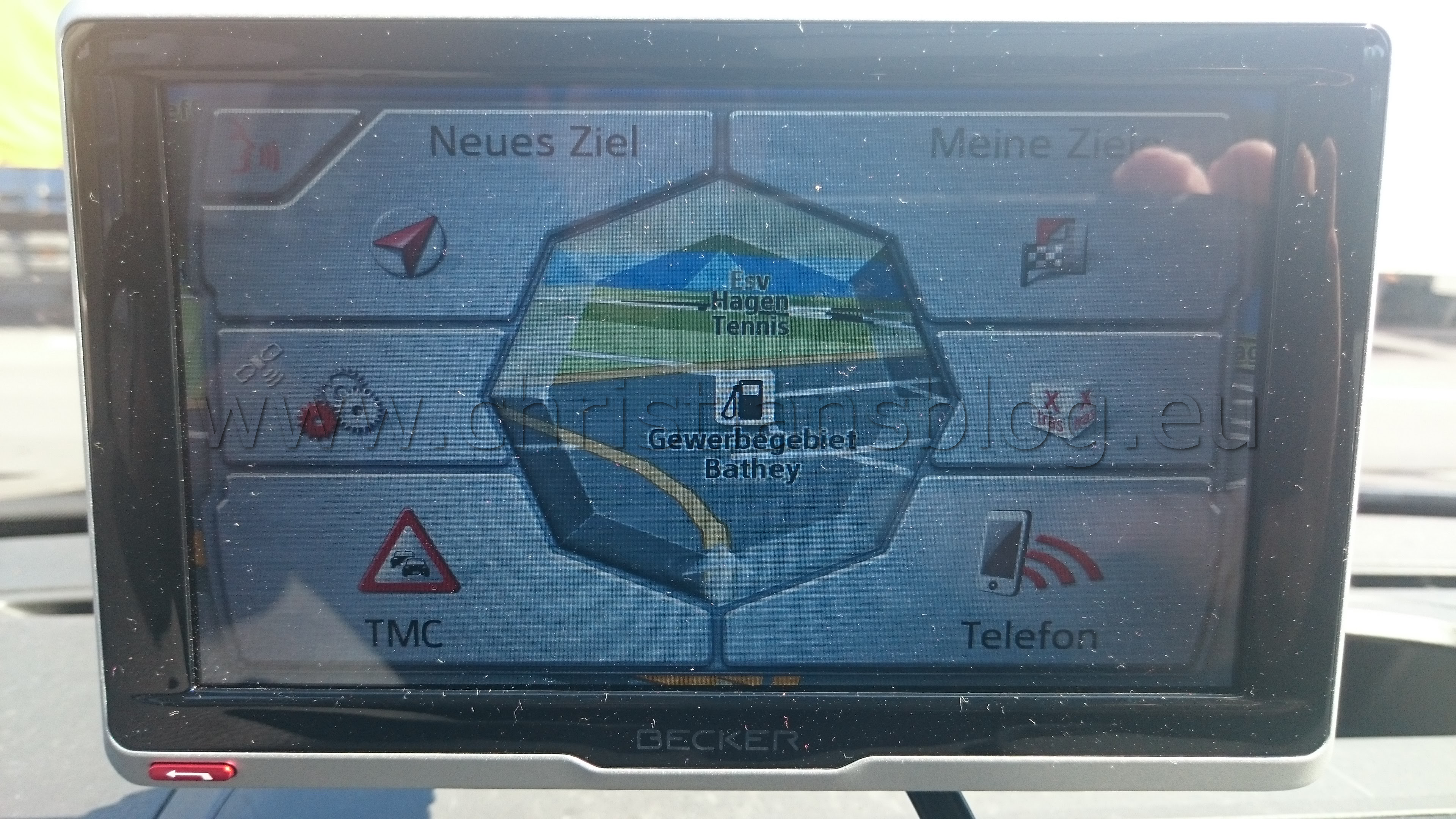
For four weeks, I had the opportunity to test the Becker transit.6 LMU in my professional daily routine. The comparison device was the Snooper Truckmate Pro S8000. Both devices are specifically designed for professional drivers – yet significant differences became apparent during daily use.
One thing upfront:
Both devices could navigate without any problems.
The Test Devices
The Becker transit.6 LMU features a high-quality real glass display and includes an integrated WLAN function. This allows not only comfortable downloading of map updates but also utilizing current traffic information from the internet.
In contrast, the Snooper Truckmate Pro S8000 offers additional multimedia functions such as DVB-T and radio. However, WLAN must be foregone in this case.
There were also price differences:
- Becker transit.6 LMU: 399 € (RRP)
- Snooper Truckmate Pro S8000: 579 € (RRP)
Navigation in Everyday Use
Although both devices were configured with identical vehicle data, it became apparent after a short time that the Becker frequently calculated more sensible routes.
On multiple occasions, the Becker displayed routes up to 20 kilometers shorter than those of the reference device.
A major reason for this was likely the use of current internet traffic data.
Traffic Jam Avoidance
The traffic jam assistant was particularly positive.
With the Becker, it is possible to set a delay threshold from which an alternative route should automatically be suggested. During the test, 15 minutes were set.
Especially in professional daily life, this function proved significantly more flexible than the pure TMC evaluation of the comparison device.
Parking Assistant
For long-haul drivers, the integrated parking assistant is particularly interesting.
Upon reaching the destination, the device suggests suitable parking options in the vicinity. These can be displayed both on the map and in list form.
The original images can be inserted here again.
Bluetooth Hands-free Functionality
I was also pleasantly surprised by the voice quality of the integrated Bluetooth hands-free function.
While I frequently experienced communication problems with other navigation devices, the voice quality with the Becker was clear and distinct.
Geocoordinates
Like many Becker devices, the transit.6 LMU also supports the entry of geocoordinates.
This function is extremely helpful, especially at company entrances where the postal address does not lead exactly to the delivery location.
Criticism Points
Of course, the test did not proceed without criticism.
Unnecessary Exits at Motorway Interchanges
At some motorway interchanges – for example Dortmund/Unna – the device regularly wanted to lead me off the motorway only to immediately get back onto the same motorway again.
This is not only unnecessary but can be problematic, especially during high traffic volumes.
WLAN Updates on the Move
The automatic update function works reliably – however, also when the device is connected to the internet via a smartphone hotspot.
During the test, my mobile data volume increased from about one gigabyte to nearly three gigabytes per month as a result.
I would have wished for an option to distinguish between home WLAN and mobile data connection here.
Known Route Closures
The Becker transit.6 LMU also did not reliably recognize some known truck route closures.
For example, the Leverkusen Bridge was still included in the route planning.
Voice Control
Although the device has voice control, it did not work reliably during the test.
Since I prefer to enter destinations manually anyway, this point played only a subordinate role for me.
Conclusion
Although I personally rarely need navigation devices, the Becker transit.6 LMU convinced me in everyday use.
Especially the internet support, intelligent traffic jam avoidance, and practical additional functions make the device a good companion for professional drivers.
Of course, even the best navigation device does not replace common sense. Nevertheless, it was shown multiple times during the test that current online traffic data offer real added value compared to pure TMC navigation.
From the perspective of that time, the Becker transit.6 LMU was therefore a recommended truck navigation device with a convincing price-performance ratio.