

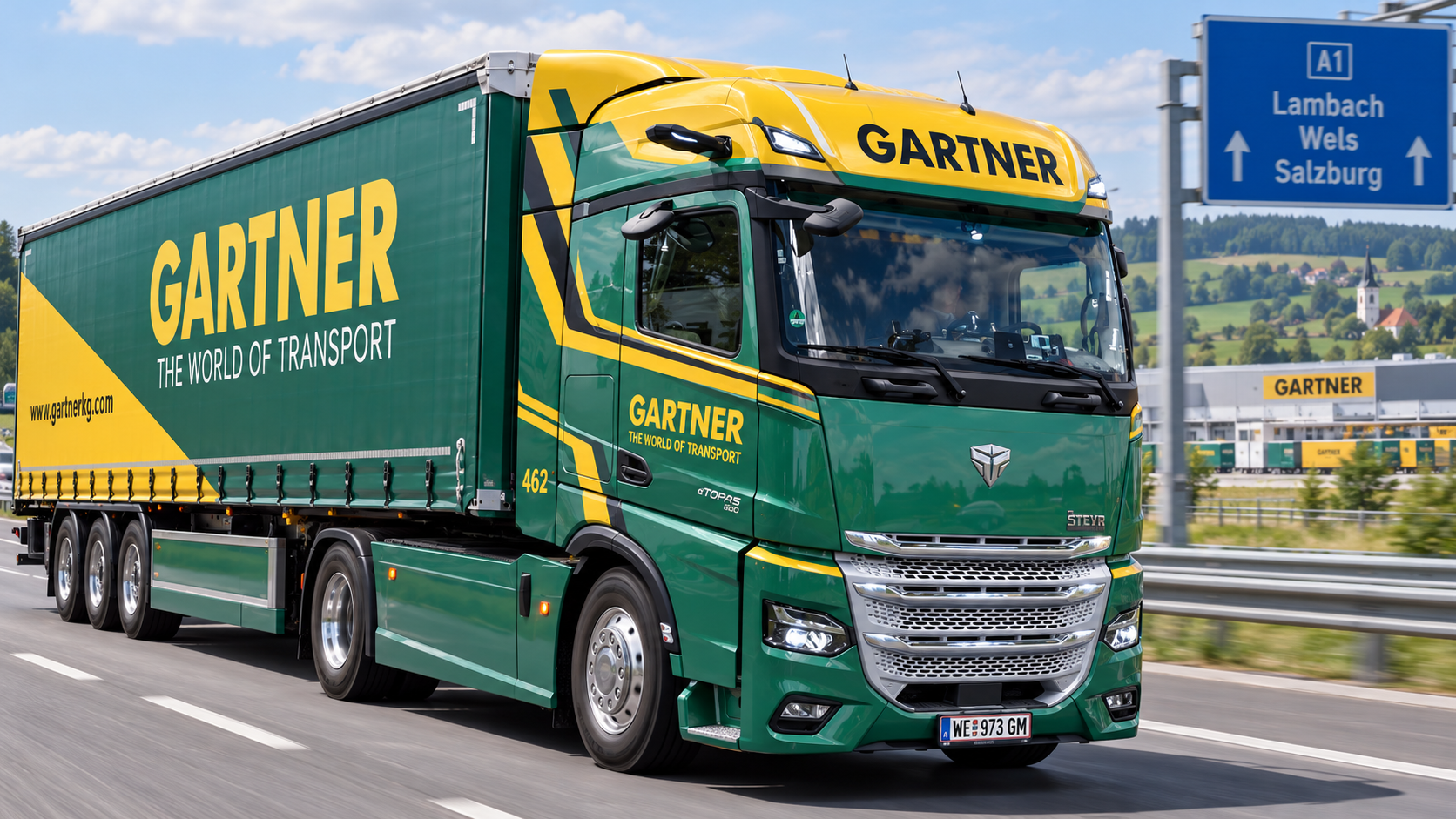
Austrian haulier Gartner has ordered 40 fully electric tractor units. Half will come from MAN, and the other half from Chinese manufacturer SuperPanther. Deliveries are scheduled to begin in early 2027. This order not only shows that electric trucks are increasingly gaining ground in the transport sector, but also indicates a shift in competition among commercial vehicle manufacturers.
Gartner KG, based in Lambach, Austria, is one of Europe’s larger transport companies with around 2,700 tractor units and over 4,000 trailers. Anyone researching the company will quickly encounter one manufacturer: MAN.
Over 80 percent of Gartner’s fleet consists of vehicles from the Munich commercial vehicle manufacturer. In May 2025, both companies agreed on a framework contract for the delivery of up to 1,200 additional diesel tractor units by the end of 2028.
Given this context, Gartner’s order of 20 electric MAN eTGX vehicles is hardly surprising. What is remarkable, however, is the other half of the order. In addition to the German vehicles, 20 SuperPanther eTopas 600 units are set to join the fleet.
SuperPanther is a Chinese manufacturer that has so far been little known in Europe and only began serial production of its electric tractor unit in Austria this summer.
Chinese Technology, Final Assembly in Austria
SuperPanther is still a young company specializing in electric heavy-duty commercial vehicles. With the eTopas 600, the manufacturer aims to establish itself in the European market.
In doing so, SuperPanther follows a slightly different approach than simply importing vehicles from China. Since July 2026, the tractor units will be finished in Austria at the Austrian company Steyr Automotive. The vehicles are produced there using the so-called Semi-Knocked-Down (SKD) process.
This means that major subassemblies are delivered pre-assembled and then assembled in Austria. Components originating from China include, among others, the electric powertrain and parts of the power electronics. Other components are supplied by European suppliers such as ZF, Schaeffler, and Continental.
Therefore, it cannot be said to be a fully European development or production. However, it is also not a completely finished Chinese truck imported ready-made.
The first customer vehicles are already on the road. At the end of July, vehicles were handed over to DHL and other European companies, among others.
With Gartner’s order, another major logistics provider is now joining. Based on previously published information, this represents the largest known single order for SuperPanther in Europe.
What’s Inside the SuperPanther eTopas 600?
Technically, the eTopas 600 is quite interesting. The electric 4x2 tractor unit features a lithium iron phosphate battery from Chinese manufacturer CATL with a capacity of 621 kWh.
The two electric motors deliver a combined continuous output of 394 kW, which corresponds to approximately 535 horsepower. The peak power available for short periods is even 692 kW or around 941 horsepower.
Regarding range, SuperPanther claims up to 560 kilometers on a single battery charge. The manufacturer cites an average energy consumption of about 1.1 kWh per kilometer for this. According to Steyr Automotive, previous test drives under various operating conditions achieved an average of about 0.95 kWh per kilometer.
Such figures are naturally initially manufacturer specifications or results from documented test drives. How the vehicles perform later in regular haulage operations will have to be seen.
Anyone who regularly travels with a fully loaded tractor unit knows, after all, how topography, outside temperatures, speed, and actual train weight can influence energy consumption.
However, what I find particularly interesting is the charging technology. The SuperPanther features two CCS2 charging ports, one on each side of the vehicle. Both ports can be used simultaneously, enabling charging powers of up to 660 kW.
Under appropriate conditions, the battery should be able to charge from 20 to 80 percent in around 38 minutes.
This sounds quite good at first glance. However, the charging infrastructure must also actually be able to provide this performance. Two charging ports on the vehicle alone are not enough for that.
I am not entirely unfamiliar with SuperPanther. At IAA Transportation in September 2026, I had the opportunity to drive the eTopas 600 myself. The test train was not empty, but also not completely full, weighing in at around 35 tons on the scales. And I must say, especially the acceleration impressed me quite a bit. My arms get tired pretty quickly when stepping on the right pedal. 😄 The chassis felt somewhat different to me. It was too soft for my personal taste and sometimes even a bit spongy, even though it is fully air-suspended. Otherwise, the truck made a quite decent impression on me.
Of course, a short test drive at IAA cannot be compared with several weeks in regular long-haul traffic. But I was at least able to get a first impression of the vehicle. My detailed experiences, further images, and technical data can be found in my article IAA Transportation 2026: Asia on the March .
And What Can the MAN eTGX Do?
The MAN eTGX is no longer just a development project. The electric tractor units are already in operation with various transport companies. Gartner also uses electric MAN vehicles on individual routes in Germany.
Depending on the configuration, MAN offers different battery sizes. For the previous 4x2 tractor unit with six battery packs, the manufacturer states a usable battery capacity of up to 480 kWh and a range of up to 570 kilometers under favorable operating conditions.
Newer variants are equipped with larger batteries. For the current generation with six battery packs, MAN cites a battery capacity of up to 552 kWh and a range of up to 660 kilometers.
For charging, MAN also relies on high power levels. Via the Megawatt Charging System (MCS), charging powers of up to 750 kW are planned for the eTGX.
However, it is not yet known which specific vehicle and battery configuration Gartner has ordered. Therefore, a direct technical comparison would only be partially meaningful at this point.
More interesting will undoubtedly be how both manufacturers perform in daily operations later on.
Range on paper is not decisive
In my view, the discussion about electric trucks still focuses far too often solely on range.
The question of whether a tractor unit can cover 500 or 600 kilometers on a single battery charge is by no means the only criterion. A transport company must know whether the vehicle can be used economically on its routes.
This includes actual energy costs, available payload capacity, charging times, and of course the question of how reliably a vehicle functions over several years.
Especially with a new manufacturer like SuperPanther, workshop support will also play a role. A truck that is out of service for several days due to a technical problem ultimately costs money. It does not matter whether it runs on electricity or diesel.
From the driver’s perspective, there are many other questions to consider.
How is the cab designed? How well does the heating function in winter? What impact does a longer standstill with climate control switched on have on range? How reliably does charge planning work? And how easily can a necessary charging break be combined with prescribed driving and rest times?
Especially in long-haul transport, everyday usability is not decided solely based on a technical data sheet.
Therefore, I would find a comparison between the two vehicle types in regular Gartner operations much more interesting than any test drive under optimal conditions.
It won’t work without charging infrastructure
Gartner does not limit its investment to the vehicles alone. At its headquarters in Lambach, twelve DC fast-charging stations for electric tractor units are being built simultaneously.
The total investment volume for the vehicles and infrastructure is estimated at around 9.6 million euros. Of this, about 40 percent is intended for charging infrastructure and 60 percent for the vehicles. Around 3.5 million euros are funded by the Austrian Research Promotion Agency (FFG).
In the medium term, Gartner plans to electrize up to 70 vehicles in its fleet.
The own charging infrastructure is a decisive factor here. Those who can regularly charge their vehicles at the depot are less dependent on public charging points. In addition, stand times can be better integrated into transport planning.
However, this looks different for international long-haul transport.
There must be powerful public charging locations available that can also be accessed with a complete tractor-trailer combination. And this must be possible without first having to park the trailer somewhere else.
As long as this infrastructure is not sufficiently available, electric long-haul transport remains a planning challenge. Even larger batteries will not change that much.
And what about subsidies in Germany?
Gartner receives around 3.5 million euros in funding for the electrification of its fleet and the setup of charging infrastructure in Austria. But what does this look like in Germany? What support does a freight forwarder receive if it also wants to acquire electric trucks and charge them on its premises?
At least in North Rhine-Westphalia, there is an interesting option for this. Through the funding program progres.nrw – Low-Emission Mobility, small and medium-sized enterprises can receive grants for fast-charging infrastructure.
Since August 2026, the funding amounts to a maximum of 30 percent of the eligible investment costs, capped at 30,000 euros per charging point. Among other requirements, each funded charging point must be able to provide at least 50 kW of charging power.
What this concretely means can be illustrated with an example from practice.
In our company, the costs for a ready-to-use charging pillar are currently calculated at around 120,000 euros. This includes acquisition, installation, and commissioning.
If these 120,000 euros were fully eligible for funding, our employer could receive a grant of 36,000 euros with an appropriate installation. The remaining investment would thus drop to 84,000 euros.
And even if the charging pillar has two charging points, this does not automatically mean 60,000 euros in funding. Although the upper limit is 30,000 euros per charging point, the funding remains limited to a total of 30 percent of the eligible costs.
In addition, external implementation concepts for the electrification of heavy-duty vehicles can be funded in North Rhine-Westphalia. This allows, for example, to examine which vehicles are suitable for existing routes, what charging power is needed at the depot, and whether the existing grid connection is sufficient.
A direct, generally accessible purchase premium for electric long-haul trucks does not currently exist at the federal level. Here, appropriate financing programs come into particular consideration.
Of course, the promotion cannot simply be transferred from North Rhine-Westphalia to all of Germany. The programs differ by state, and company size also plays a role.
Nevertheless, this example shows that the transition to electric commercial vehicles does not have to be solely a matter for large logistics companies with several hundred or even thousands of vehicles.
Smaller operations can also engage with this topic. Ultimately, what matters is whether the vehicles fit the existing transport orders, which investments are necessary, and how costs develop over several years.
Further information: progres.nrw – Low-emission mobility
What does Lidl have to do with this?
One more detail of the Gartner order is worth mentioning.
Since August 2024, Lidl International Services GmbH has held 35 percent of the shares in Gartner. In the published images regarding the vehicle orders, a representative from Lidl’s product development can also be seen.
This does not automatically mean that the new electric trucks will in the future travel exclusively or predominantly for Lidl. Concrete deployment routes have not yet been published by Gartner.
However, it is interesting in this context that Lidl itself has already experimented with electric and even autonomously driving commercial vehicles.
Since September 2026, the discount retailer has been testing a fully electric truck without a driver’s cabin together with the Swedish technology company Einride in Edermünde near Kassel in Hesse.
The vehicle operates according to the SAE Level 4 automation standard and possesses the corresponding approval from the Federal Motor Transport Authority (Kraftfahrt-Bundesamt). It transports goods between a Lidl distribution center and a nearby store. However, this is a fixed route of only about 400 meters.
The truck offers space for 15 Euro pallets and is intended to be used up to three times daily during the four-month test operation. In total, more than 3,000 pallets could be transported in this way.
Even though the truck drives autonomously, it should be noted that it does not travel completely unattended. At least during the previous test operation, an employee accompanied the vehicle with a remote control to intervene if necessary.
Of course, this experiment has little in common with international long-haul transport. Nevertheless, it shows that Lidl is trying new paths not only with electric drives but also with the automation of its transport processes.
Whether there is a direct connection between this project and the order of 40 electric trucks by Gartner is unknown. However, both developments show that Lidl or the Schwarz Group is intensively dealing with the future design of its transport logistics.
Electric trucks can be particularly interesting for trading companies when regular transport routes, own logistics centers, and predictable vehicle downtime come together.
Whether and to what extent the new Gartner vehicles will be used for Lidl in the future remains to be seen.
Further information: Lidl and Einride bring autonomously driving electric truck onto public roads
Competition grows for European manufacturers
The fact that Gartner considered two manufacturers in its order is likely not a coincidence. Large transport companies can thus test different vehicle concepts within their own operations and gain experience.
For MAN, the order is initially another contract for 20 electric tractor units. For SuperPanther, however, it may have significantly greater importance.
With Gartner, the Chinese manufacturer gains a customer who has been active in European transport business for decades and possesses extensive experience with heavy commercial vehicles.
If the vehicles meet expectations, this could also become interesting for other logistics companies.
Therefore, European commercial vehicle manufacturers must prepare for the fact that Chinese companies will appear as competitors in the future not only for electric passenger cars but also for heavy trucks.
Whether SuperPanther can keep up with established manufacturers such as MAN, Mercedes-Benz Trucks, Volvo, or Scania in the long term is still open today. More than just a high battery capacity and impressive performance figures are needed for this.
Above all, the quality of the vehicles, spare parts supply, a functioning service network, and long-term operating costs will be decisive.
My Conclusion
40 new electric trucks represent a manageable proportion in a fleet of more than 2,700 tractor units. Therefore, no fundamental overhaul of Gartner’s entire vehicle park can be spoken of yet.
Nevertheless, I consider the order remarkable.
Not because Gartner would replace diesel trucks overnight with this. But because a large European transport company is apparently willing to give a chance to a new Chinese manufacturer alongside a long-term partner.
It will have to show whether the vehicles actually deliver what their manufacturers promise.
I would certainly like to find out in one or two years how many kilometers the MAN eTGX and the SuperPanther eTopas 600 have covered by then, what their actual energy consumption was, and what experiences the drivers have made with them.
Because such experiences from daily transport operations are ultimately much more informative than the most beautiful brochures.
One more note on the title image: Like almost all of my images, this one is also AI-generated. It therefore currently shows no real SuperPanther eTopas600 in the colors of Gartner KG.
