

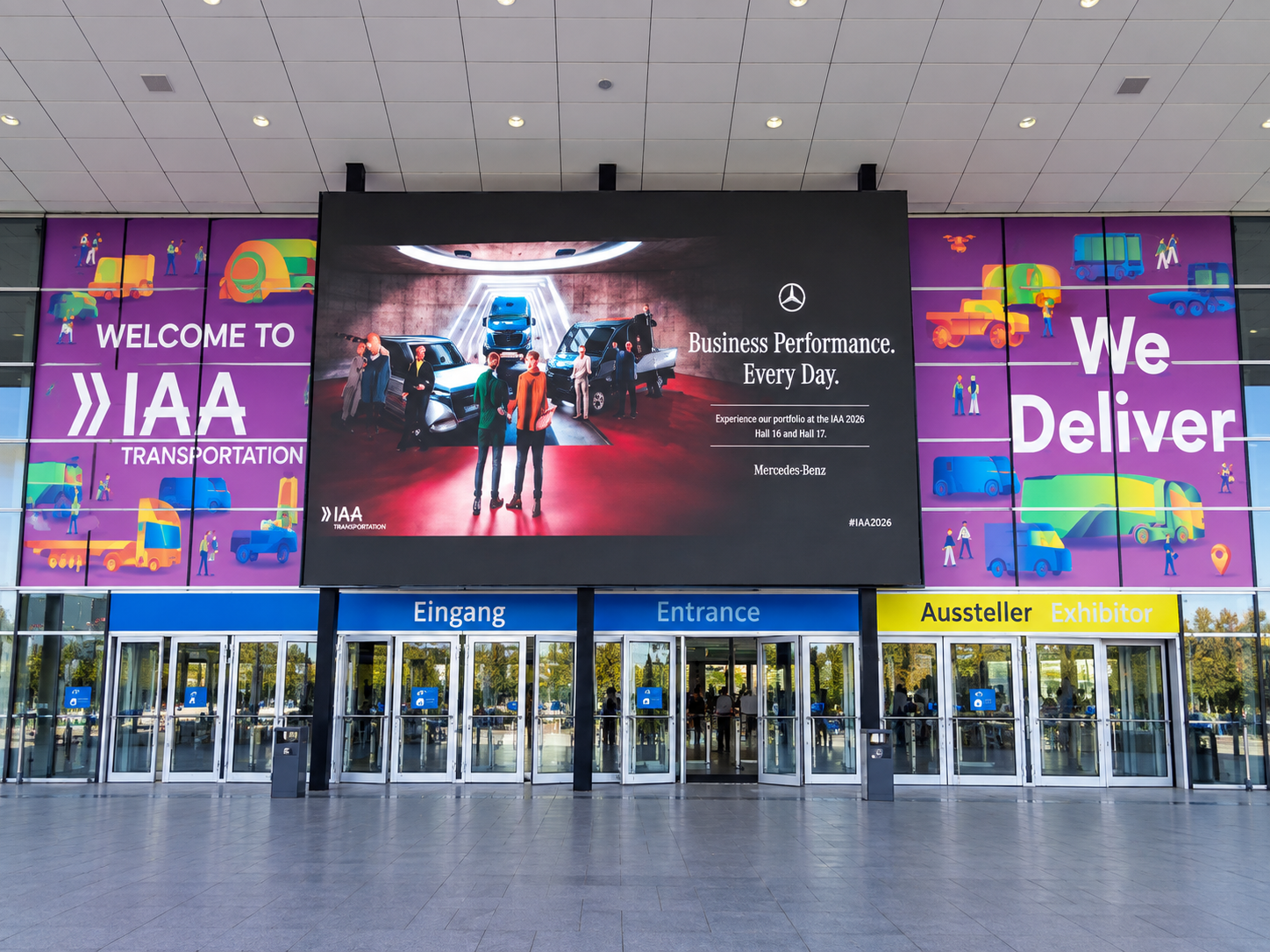
Yesterday was the press day for the IAA 2026 opening. After skipping the IAA in 2024, I was back on site yesterday.
And the trade fair world has changed for me.
In 2022, Asian vehicle manufacturers were still mostly found in smaller halls, but by 2026, things look completely different. They now dominate entire sections of the exhibition. Avoiding Asian truck manufacturers is hardly possible anymore.
Asia is on the advance
If you have been following the passenger car world, you will see that Asian manufacturers are aiming to establish a foothold in the European market. This is clearly noticeable at this year’s IAA. While the stands of European manufacturers are getting smaller, those of Asian ones are growing larger.
And as I know from Gamescom, there is also a friendly willingness to talk at the fair, although I had to admit that my English leaves much to be desired. Well, you can also get by with hands and feet. :)
But where do I start… There is so much to see at the IAA; I didn’t manage to see everything, so I will be going to Hanover again on Saturday anyway. Nevertheless, there was one highlight yesterday that must not be missing from this article.
After passing through the entrance control
As usual at the IAA, Mercedes presents a series of trucks that have left the plant over time.
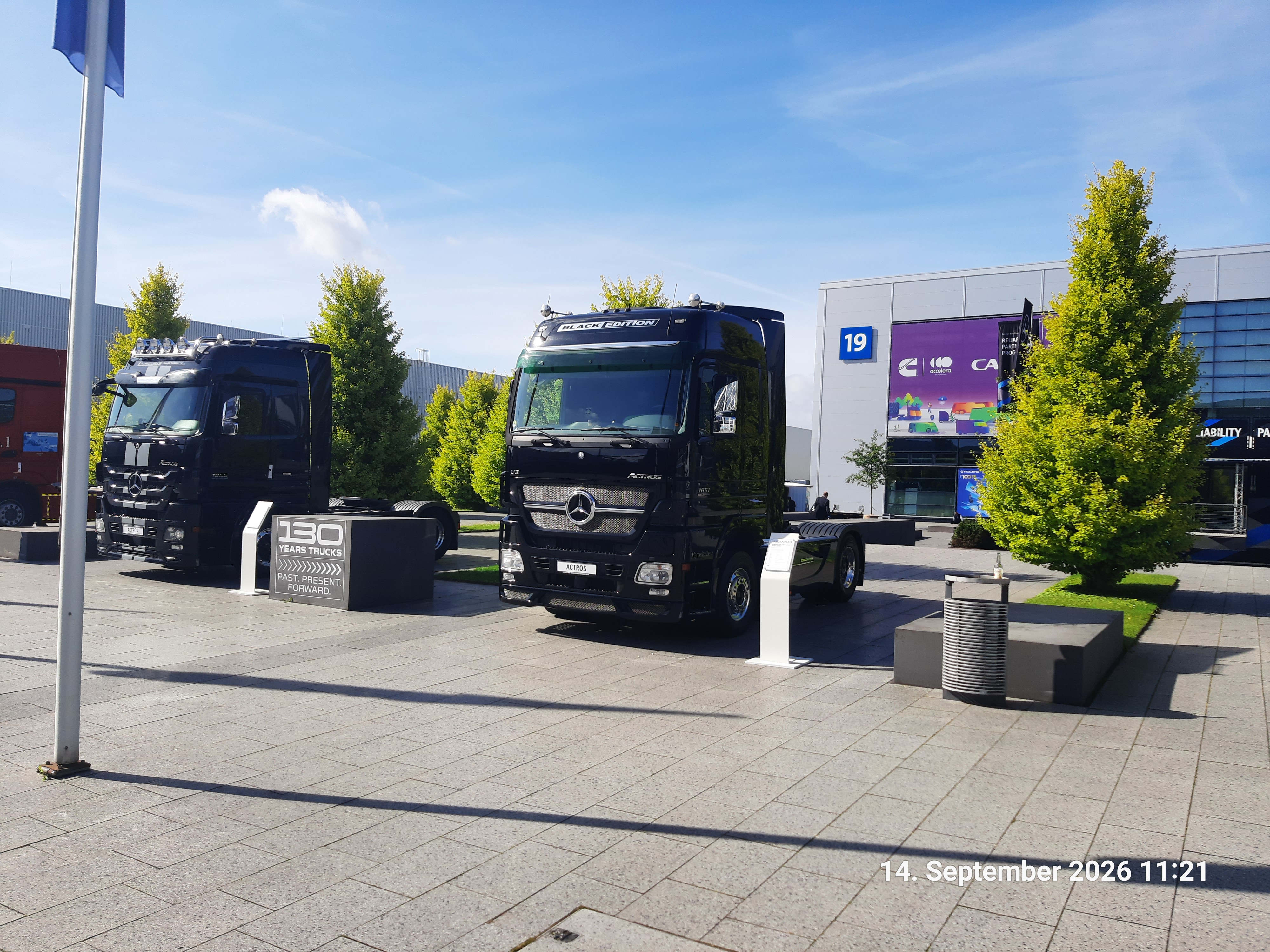
130 years of truck history at the IAA: Mercedes-Benz Trucks looks back at the beginnings of the truck and shows how transport of the future could look. I took a look around the stand and brought along a few interesting impressions.
The Mercedes stand itself
The Mercedes stand has changed. In 2016 it was still sterile, large, and simply confusing; in my opinion, it is getting smaller every year. I believe this happened around 2018 or 2020 when Mercedes began separating the truck and Sprinter segments at the fair. This can also be seen in the stand size.
And as you could already read from the trade press, Mercedes seems to want to breathe new life into hydrogen, even though neither in Germany nor in Europe is the necessary infrastructure available.
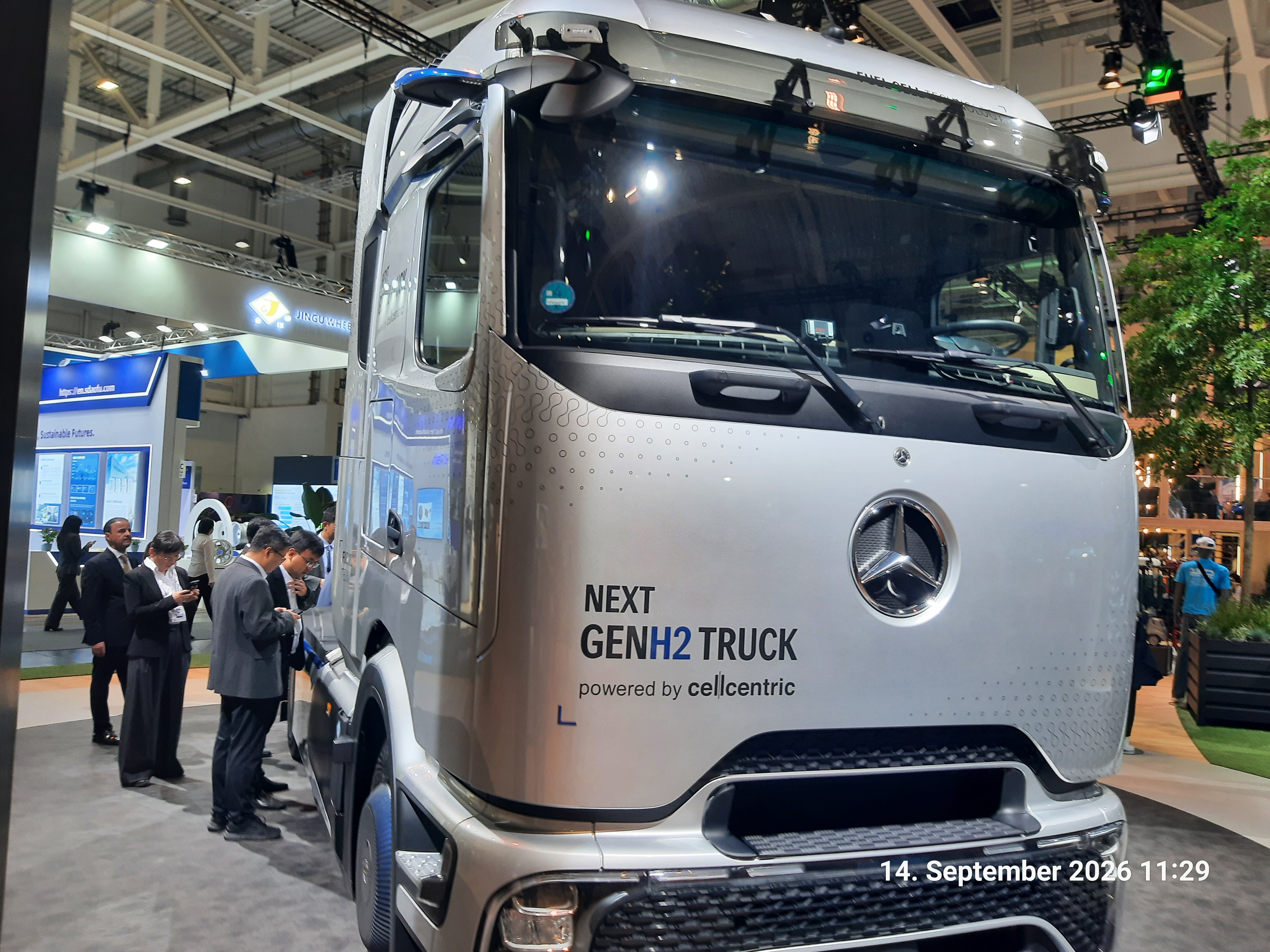
So far, I only know one hydrogen refueling station, in Göttingen near Marburg. Well, that doesn’t mean much.
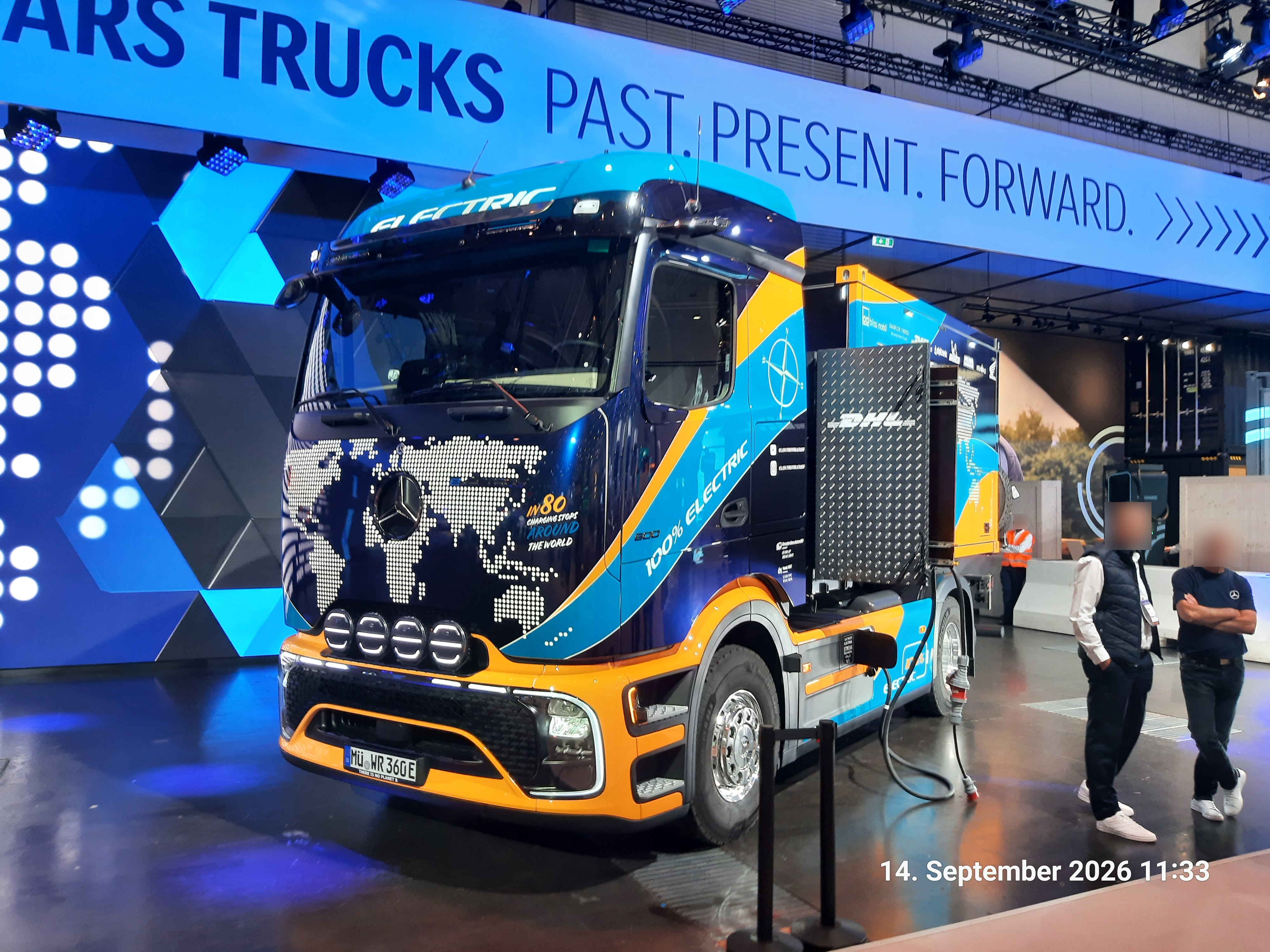
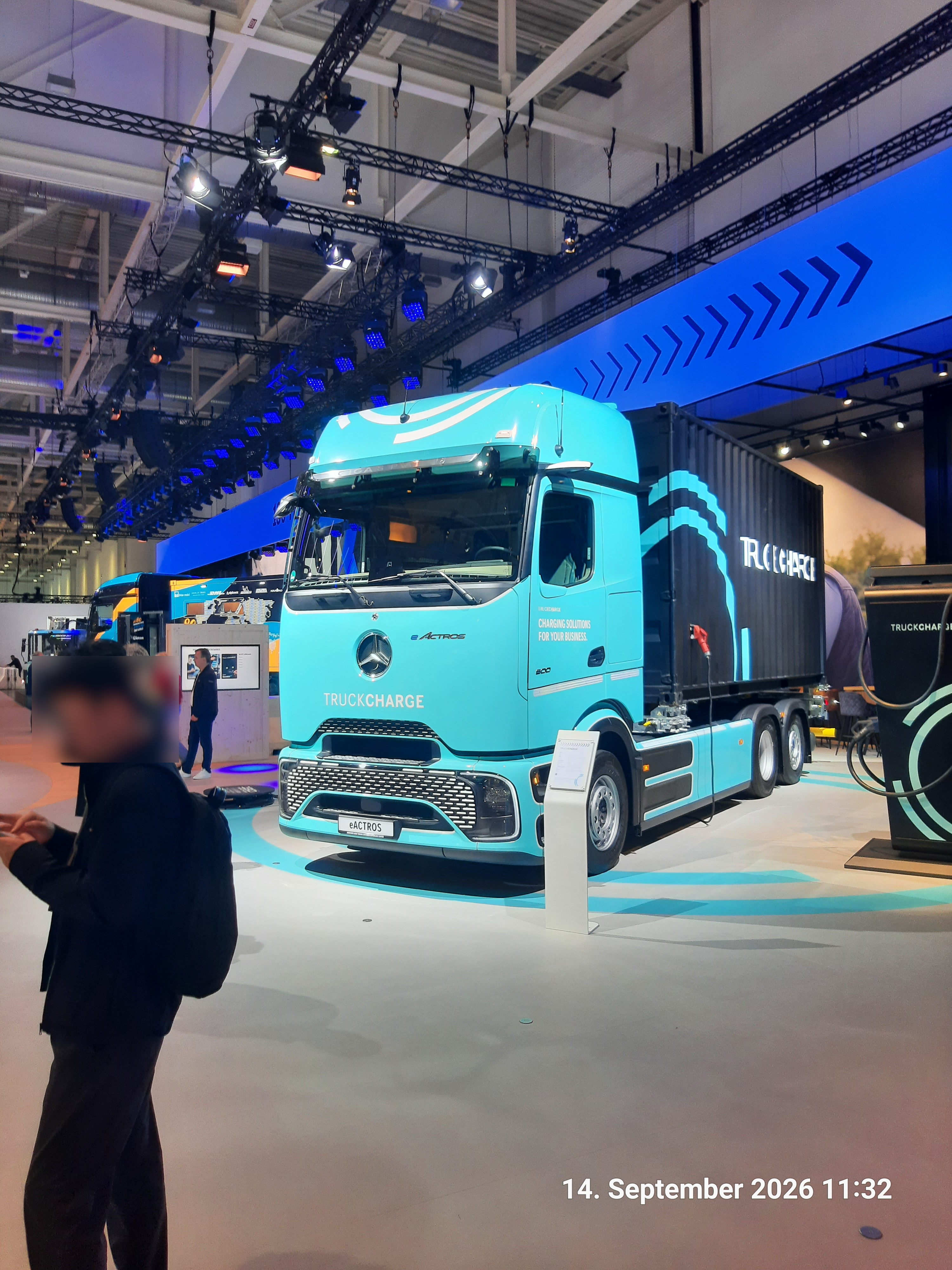
“Around the world in 80 charges” – with this specially converted eActros 600, “electric trucker” Tobias Wagner intends to drive around the world electrically. Roughly 45,000 kilometers, more than 30 countries, and a maximum of 80 charging stops lie ahead of him.
In addition to the vehicles, Mercedes-Benz Trucks also dedicates considerable space at the IAA to charging infrastructure. Under the name “TruckCharge,” the manufacturer bundles consulting, charging infrastructure, and digital solutions around the electric truck. The exhibited eActros 600 shows: When switching to electric, it is no longer just about the truck itself, but about the complete system behind it.
BYD
Of course, as a driver of a BYD Seal U DM-I , I also wanted to get to know the world of BYD commercial vehicles.
I was lucky enough that yesterday at the IAA, the BYD ETT 44 was presented as a world premiere. It is a semi-trailer tractor with a maximum of 1,000 hp.
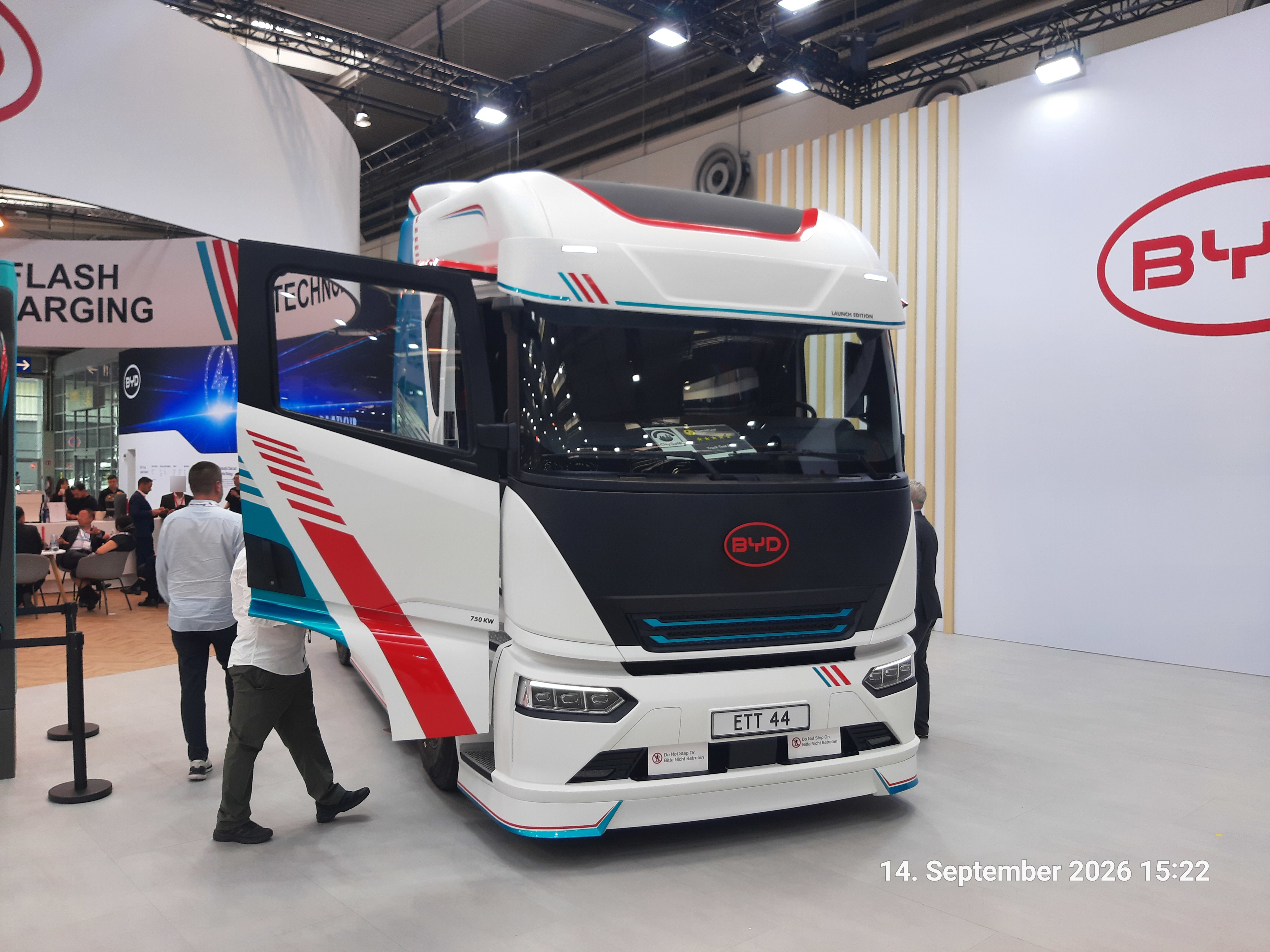
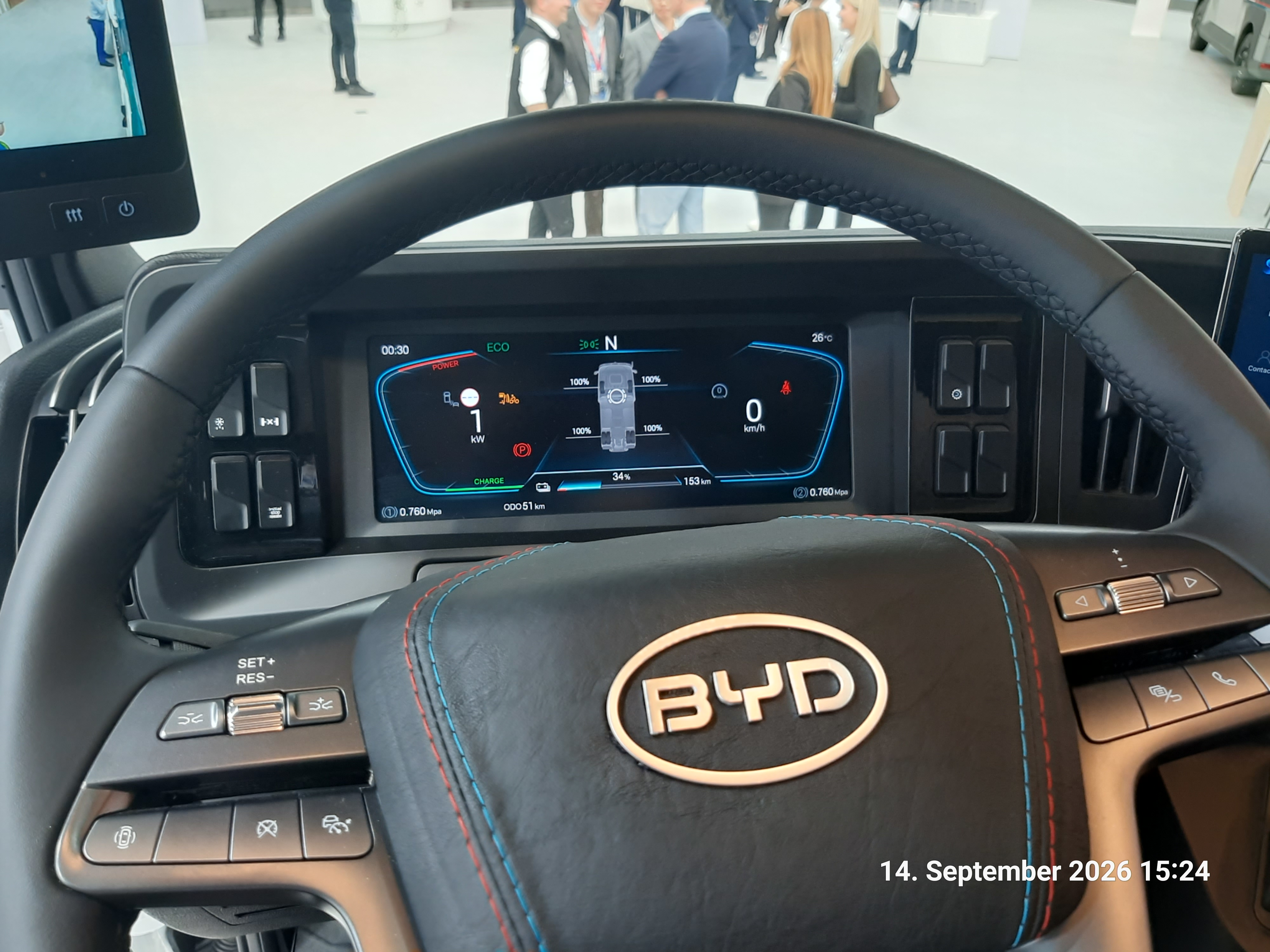
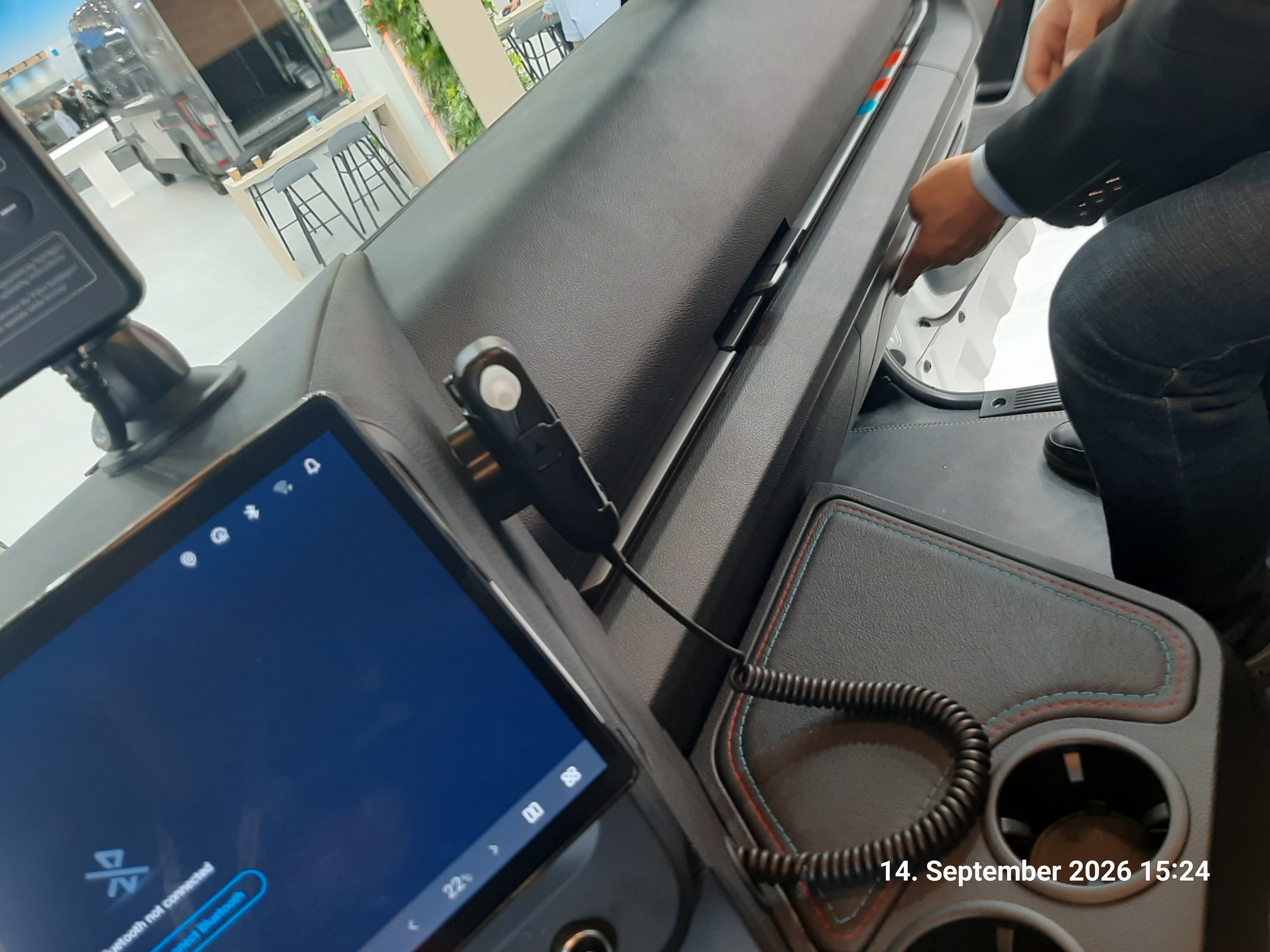

Here are the technical data of the truck:
Technical data of the BYD ETT 44
| Technical Data | BYD ETT 44 |
|---|---|
| Drive | Battery electric |
| Configuration | 4×2 Semi-trailer tractor |
| Max. Gross Train Weight | up to 44 t |
| Battery | 651 kWh Blade Battery |
| Battery Technology | LFP (Lithium Iron Phosphate) |
| Nominal Voltage | 851.2 V |
| Rated Power | 743 hp (546 kW) |
| Max. Power | up to 1,000 hp (approx. 750 kW) |
| Range | up to approx. 600 km* |
| CCS2 Charging Power | up to 420 kW |
| MCS Charging Power | over 1.5 MW |
| Charging Time 20–80% (CCS2) | approx. 60 minutes |
| Charging Time 20–80% (MCS) | approx. 20 minutes |
| Recharging via MCS | up to approx. 400 km range in 20 minutes |
| Curb Weight | approx. 10.95–11.14 t |
| Wheelbase | 3,800 mm |
| Dimensions (L × W × H) | 6,400 × 2,530 × 3,820 mm |
| Battery Warranty | 10 years / 1.2 million km |
| Safety Rating | 5 Stars Euro NCAP + CitySafe |
But the further product range in the commercial vehicle sector can also be impressive.
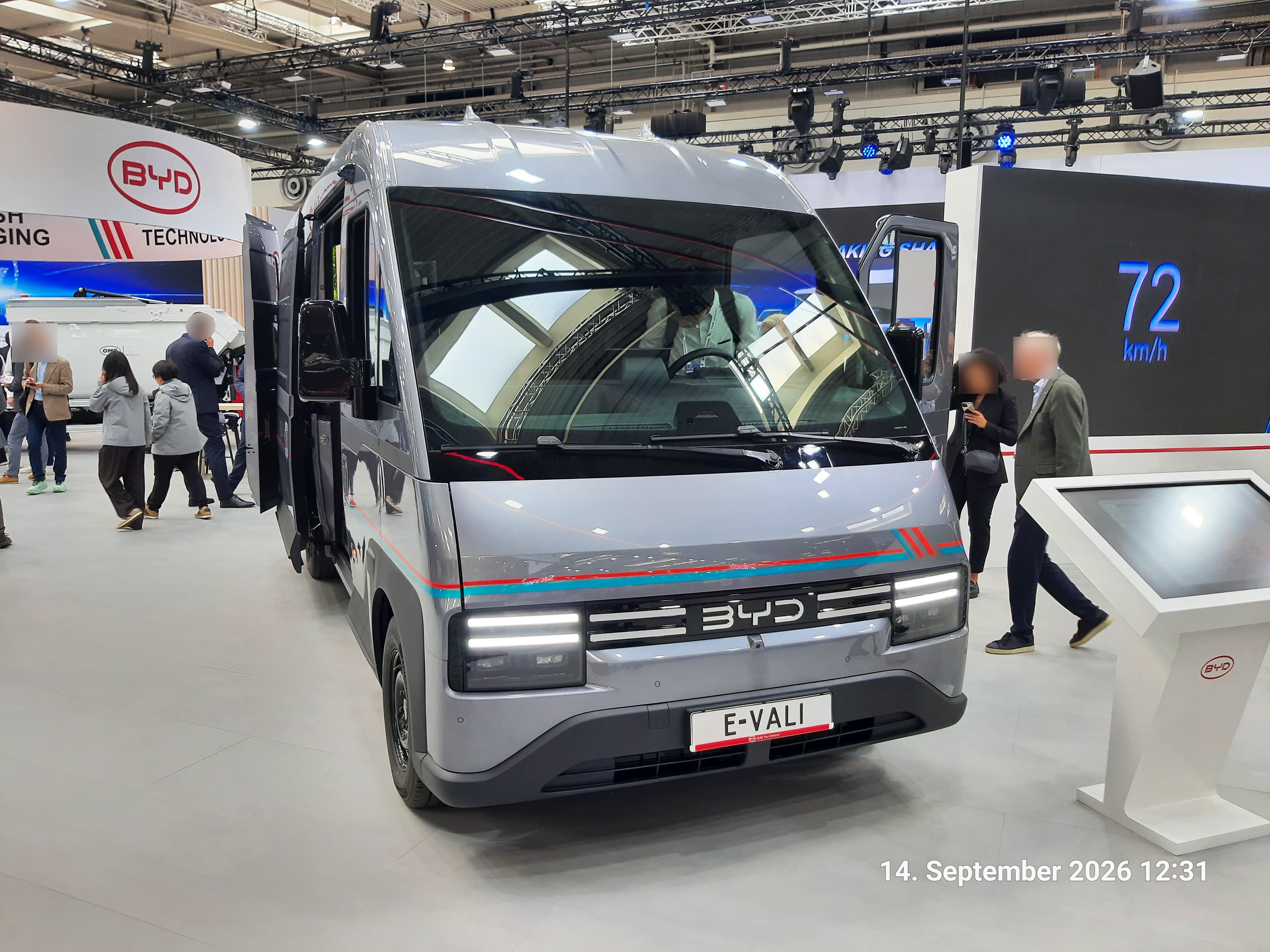


I also found a small incident in the truck amusing. A Chinese blogger sitting next to me was quite surprised when I suddenly activated voice control. We started talking, and he asked me in surprise how a European like me knew how to activate voice control on BYD vehicles.
I could then tell him about my experiences with my own passenger car.
Incidentally, BYD plans to introduce its commercial vehicle division in Europe in the second quarter of 2027. Now it remains to be seen when BYD motorhomes will be available on the European market. What I have found so far online looks quite stylish and is particularly attractive in terms of price.
The Blade Battery from BYD
One of the technologies that BYD employs across its various vehicle classes is the Blade Battery. It is based on Lithium Iron Phosphate (LFP). The name “Blade” comes from the particularly long and flat battery cells that are integrated directly into the battery pack. This allows for more efficient use of the available installation space.
A major advantage of LFP chemistry is its high thermal stability. BYD subjected the Blade Battery, among other things, to the well-known nail penetration test. In this test, a battery cell is deliberately pierced to provoke an internal short circuit. In the test published by BYD, neither smoke nor fire occurred.
This technology is not only found in BYD passenger cars. It is also used in commercial vehicles. At IAA Transportation 2026, BYD showcased the new ETT 44, an electric tractor unit whose 651-kWh battery is explicitly referred to as a Blade Battery. Thus, the technology now ranges from passenger cars and plug-in hybrids up to heavy long-haul trucks.
The ETT 44 in particular makes it clear why the construction is interesting: In a heavy electric truck, not only the battery capacity counts. Weight, installation space, thermal management, charging performance, and the mechanical stability of the entire battery system play a crucial role.
BYD is further developing the technology. In 2026, the second generation of the Blade Battery was introduced, which is supposed to enable higher energy density and significantly higher charging performances. In my Seal U DM-I , the first generation Blade batteries are still installed.
Stoneridge
Yes, I was also briefly at Stoneridge yesterday. However, I had already dealt with the company over four years ago. At that time, I sent Stoneridge an email because I did not really like a function on their tachograph.
The problem was as follows: At the beginning of the trip, the tachograph initially displays the remaining driving time of 4:30 hours. Sometime later, the display switches and shows, for example, only 1:45 hours remaining. Alongside this, a “15” and the bed symbol appear. This signals to the driver that within these 1:45 hours, he still has the opportunity to split his 45-minute break – correctly said: driving time interruption.
If I, as a driver, do not want this at all and simply continue driving, a small problem arises: Once the 1:45 hours have elapsed, the display remains at 00:00. It does not automatically switch to the remaining driving time actually still available.
Over four years ago, I was then referred to the sales partners in Germany. There, however, I could not really explain the problem or apparently reach the right department.
Yesterday, I finally had the opportunity at IAA to address the problem directly with Stoneridge. And behold: By the end of the year, a software update is supposed to come that should fix exactly this problem.
Well, I am curious now. :D
But Stoneridge does not only build tachographs. They can also equip trucks quite well with monitors. 😄
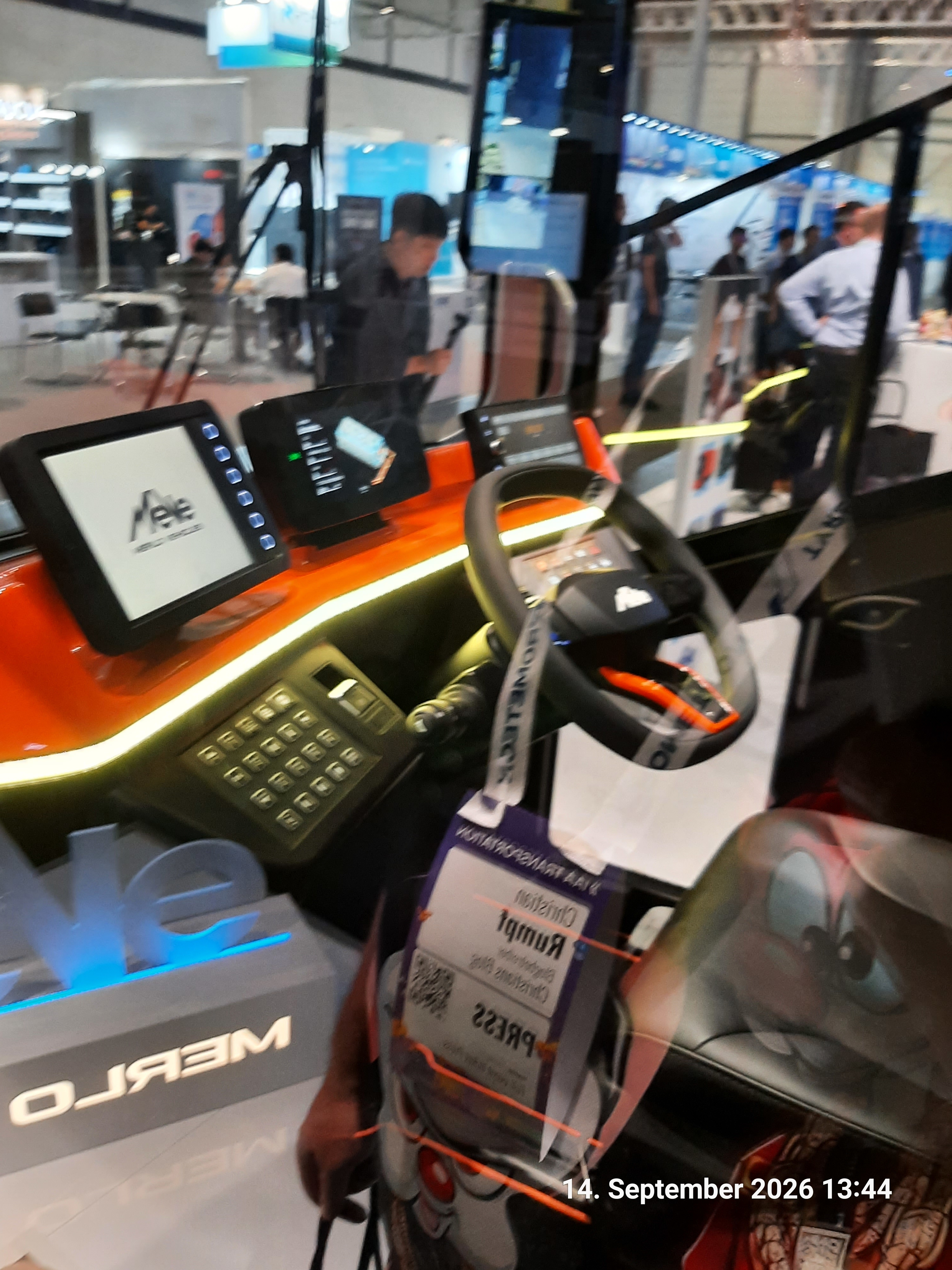
In the so-called Innovation Truck, Stoneridge shows what the driver’s workplace could look like in the future. Cameras replace the classic side mirrors here, additional displays provide further information, and the trailer should also be more integrated into the overall system. In addition come functions such as 360-degree view, trailer data, and other assistance systems.
The whole thing is less a single new function but rather an attempt to combine cameras, displays, vehicle data, and control into a networked system.
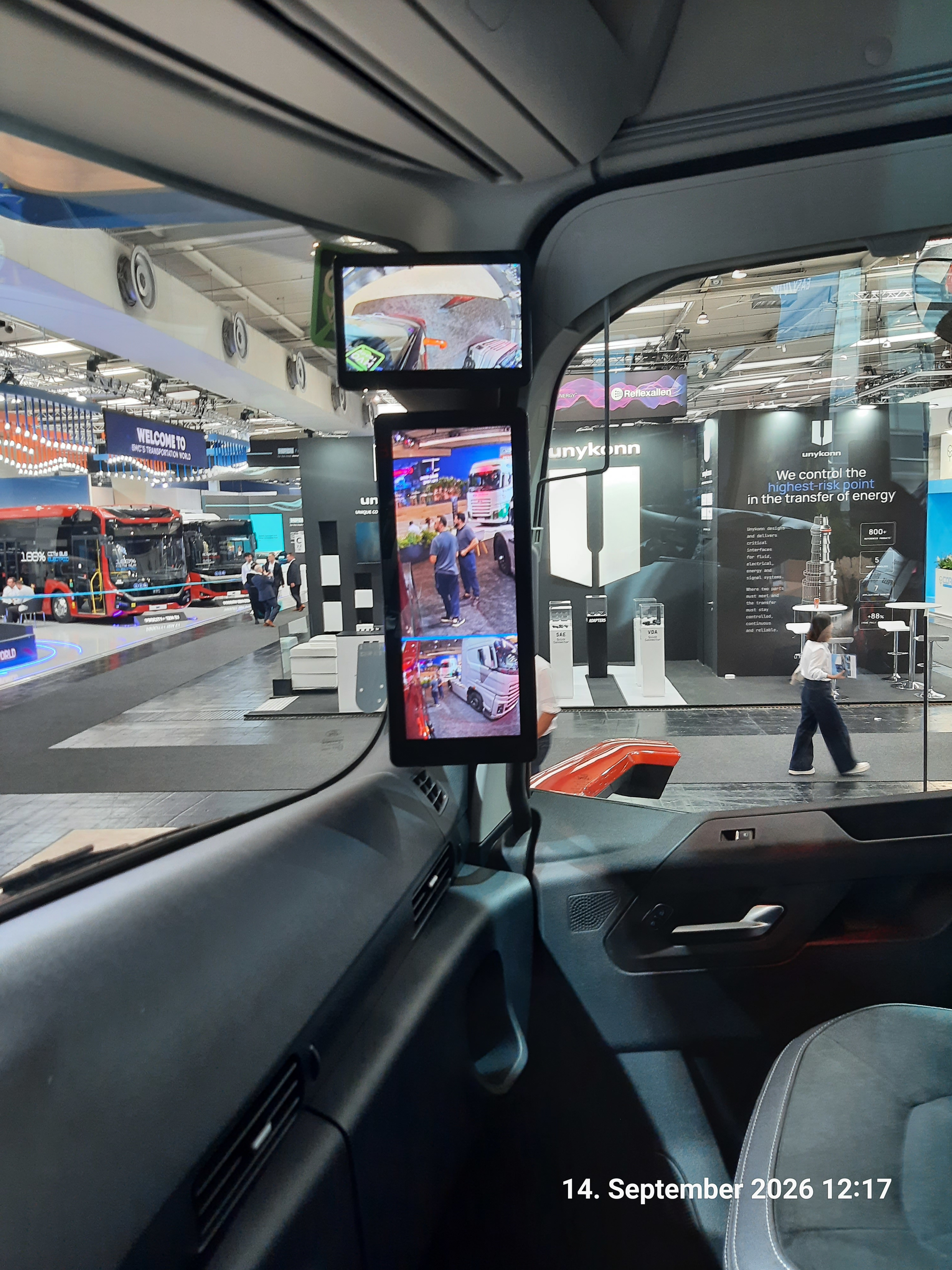
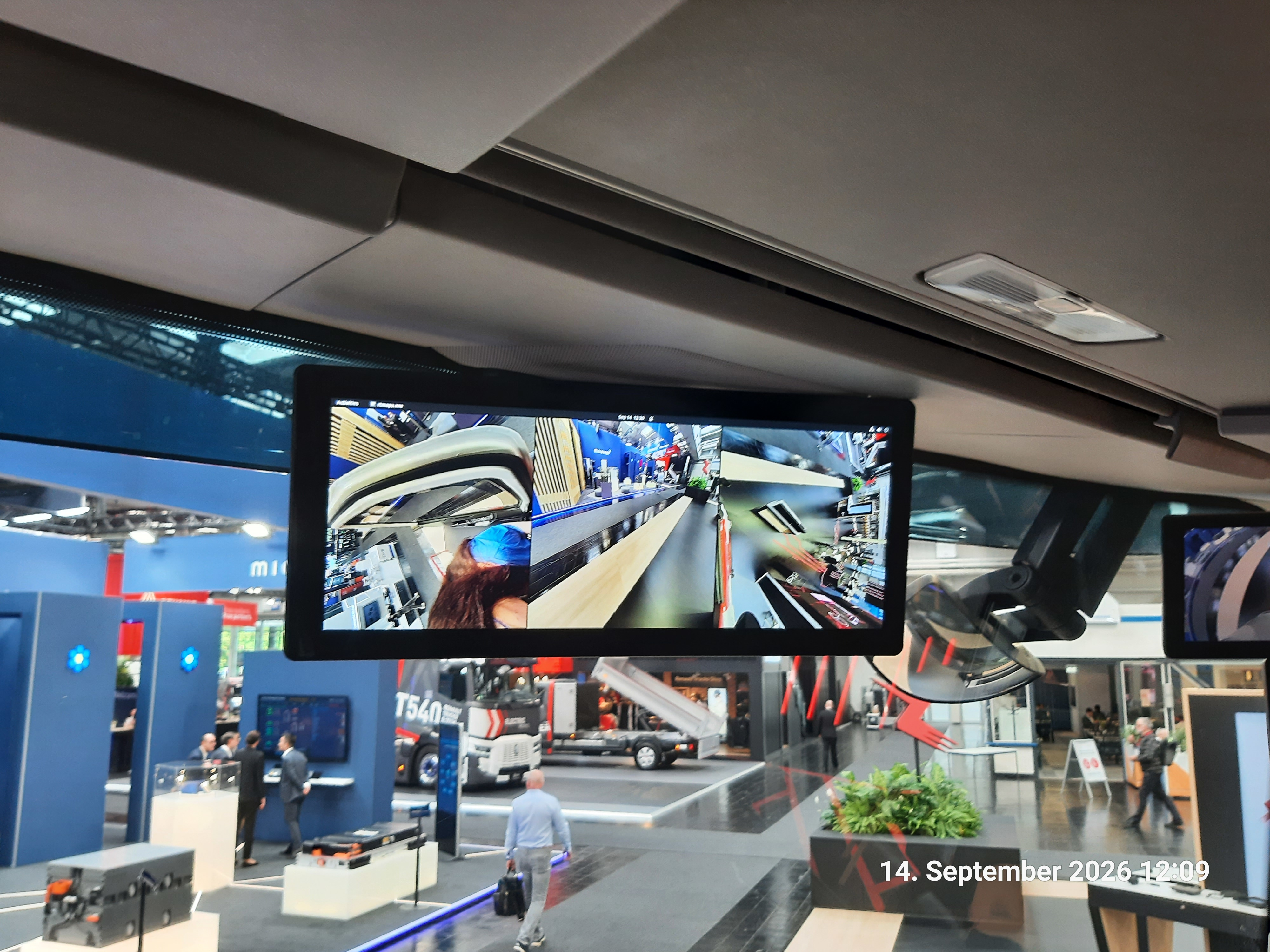
And at the latest when looking inside the cab, it becomes clear what is meant: Where two mirrors used to hang, it is slowly becoming quite full of screens. 😄 Fine for the trade fair, but clearly too much for practice. The problem here is still that I, as a human, cannot look into all mirrors/monitors at the same time.
Highlight No. 1
I had already tried to get in touch with Superpanther before IAA because their trucks interested me very much. Unfortunately, the contact data stored for IAA were incorrect, so nothing came of it. Yesterday at IAA, I could then spontaneously go for a test drive with the eTopas 600.
When I looked around at the stand of Superpanther , I was approached by one of the employees there. It was about this truck here, and what my impression would be.
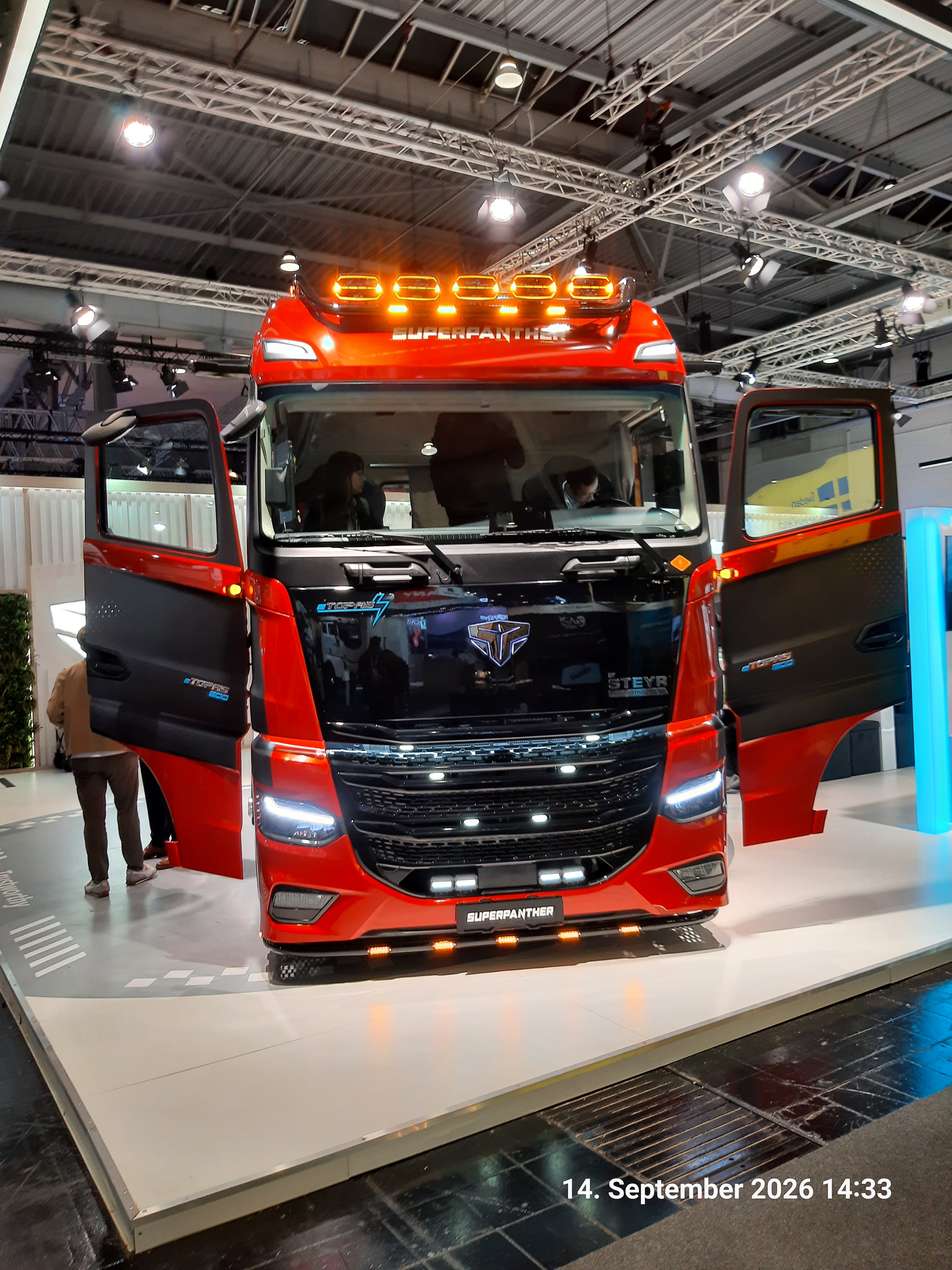
I told him that looks are not everything and asked if I could have the key. Five minutes later, I was sitting in one of the trucks available for test drives.
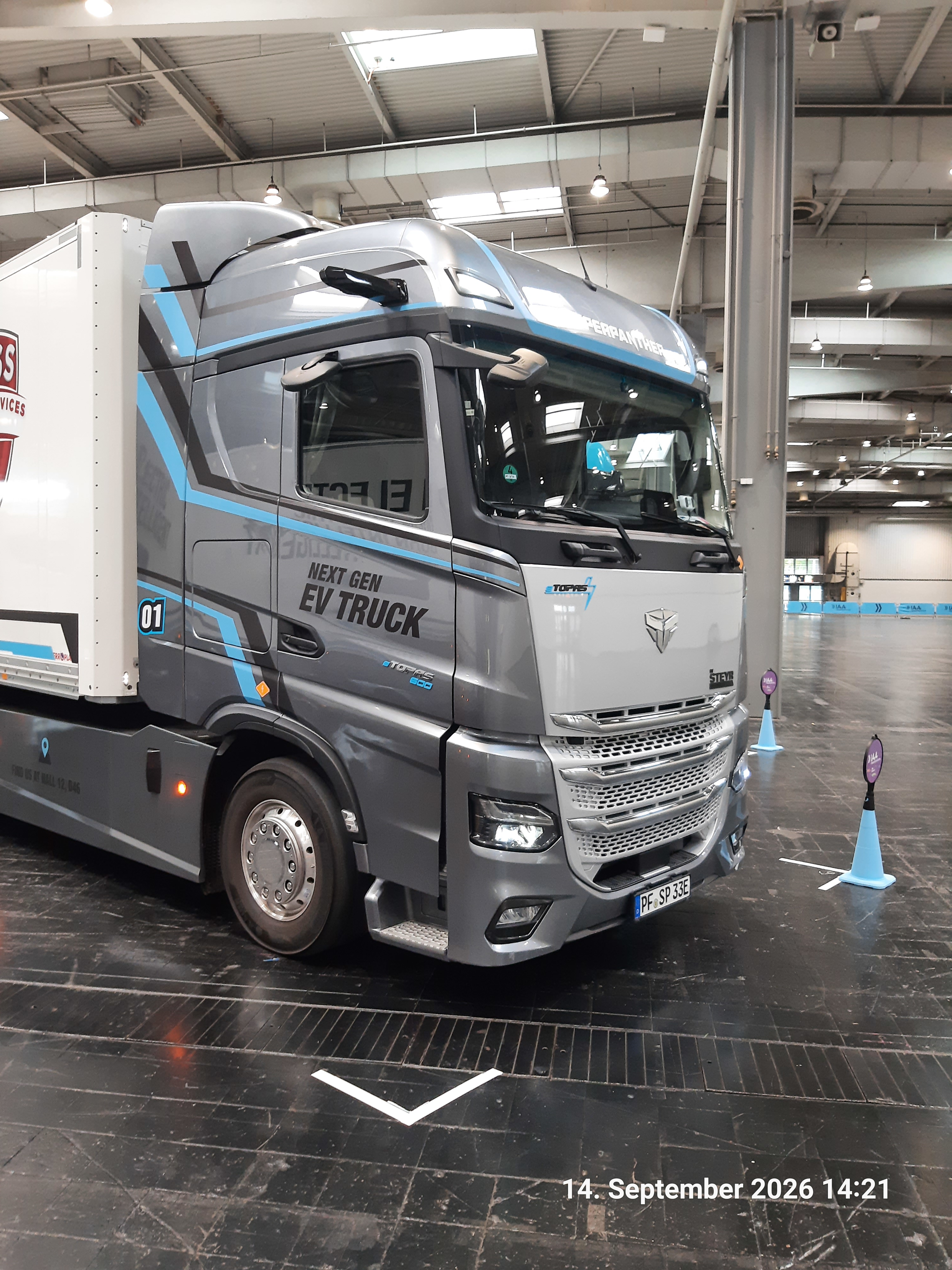
Well, the truck for the test drive has a gross weight of 35 tonnes. After all, one should judge the performance when the truck is loaded. And I must say that for this being my first ride in an electric truck, I am quite enthusiastic about the power such a vehicle possesses. The arms get a bit longer when you step on the right pedal.
You are not taken for granted with the equipment of the truck either. The standard equipment includes, among other things:
- Air-suspended driver and passenger seat
- Fully air-suspended chassis (which could perhaps be a bit firmer)
- Full leather trim.
- But also a rather large/deep refrigerator (a 1.5-liter bottle does not fit upright inside)
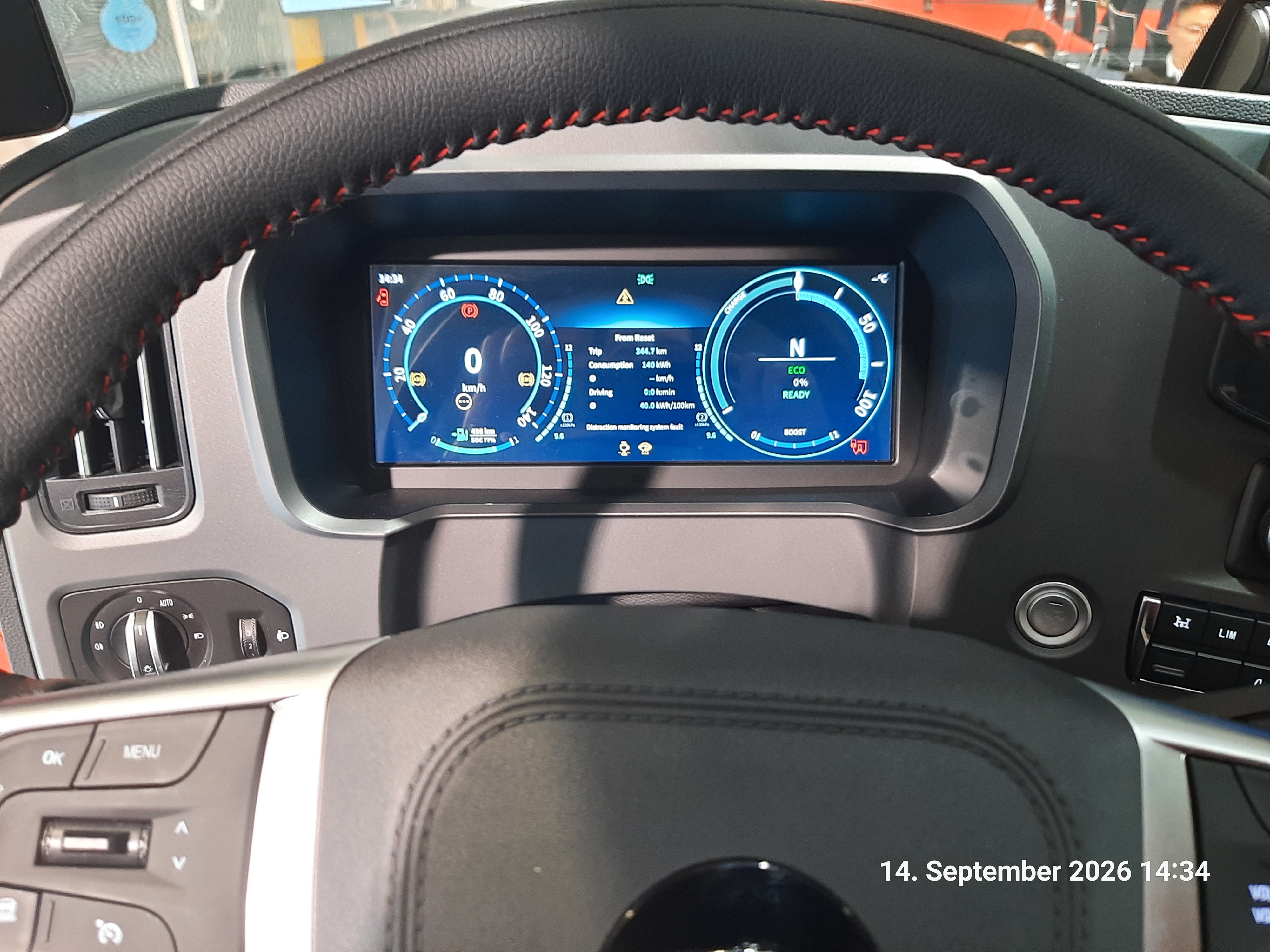
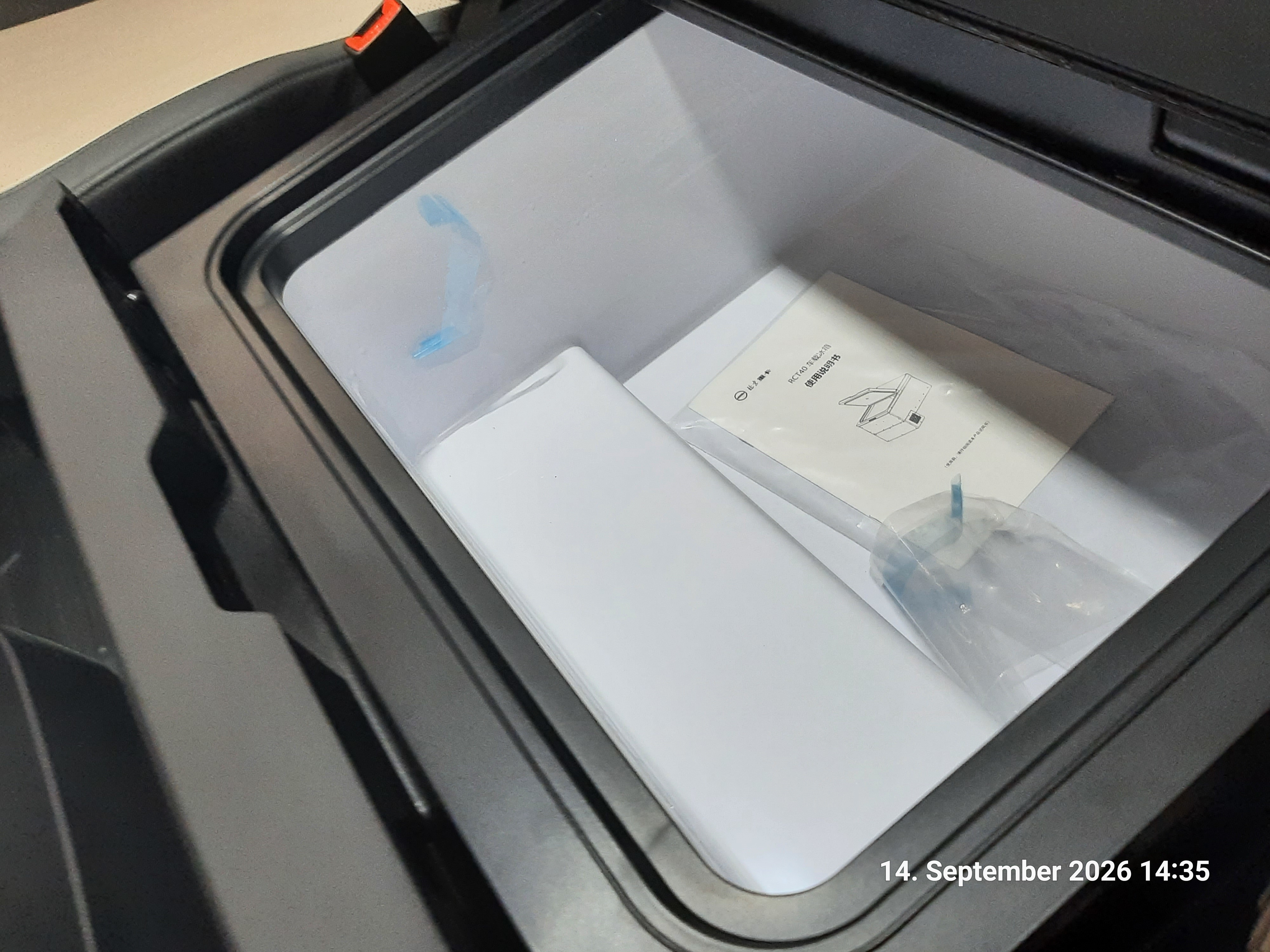
But now, my conclusion on the truck’s driving comfort: How should I put it? Except for the chassis in the test vehicle being too spongy and too soft, the truck drives quite smoothly. And yes, even if you kick it in the “ass”, you feel the power hidden in the drive train. Your arms will get tired pretty quickly.
Sorry guys, I really enjoy driving my Scania, but this acceleration… I honestly wish for that in my Scania too :)
Technical data of the eTopas 600
| Area | Technical Data | eTopas 600 |
|---|---|---|
| Range & Charging | Range | 560 km* |
| Charging time (20–80% SoC) | approx. 38 min (2× CCS2) | |
| Weight & Dimensions | Axle formula | 4×2 |
| Max. Gross Combination Weight (GCW) | 42 t | |
| Length × Width × Height | 6475 × 2560 × 3960 mm | |
| Kerb weight | 10.8 t | |
| Wheelbase | 4000 mm | |
| Front / Rear Overhang | 1450 / 1025 mm | |
| Sling coupling height above ground | 1100 mm | |
| Drive & Battery | eAxle | 13.2 t, 2 electric motors, 2-speed gearbox |
| Continuous/Maximum Power | 394 / 692 kW (535 / 941 hp) | |
| Battery | CATL, 621 kWh, LFP (Lithium Iron Phosphate), 4500 charge cycles | |
| Voltage platform | 800 V | |
| Top speed | 89 km/h | |
| Chassis & Brakes | Axle load front / rear (Air suspension) | 8 / 13 t |
| Steering | EHPS | |
| Suspension | Air suspension | |
| Brake system | EBS + ESC + AEBS + EPB + 5-stage energy recuperation | |
| Tyres | Front axle: 385/55 R22.5 Rear axle: 315/70 R22.5 | |
| Tyre puncture emergency system | ✓ | |
| Tyre pressure monitoring system for heavy goods vehicles (TPMS) | ✓ | |
| Rims | 9.00 × 22.5 Aluminium alloy | |
| Control | Drive-by-Wire | |
| Cabin | Cabin | XL cab, flat floor, sleeping cabin, 1 bed |
| Driver’s seat | Air-suspended seat, right armrest, heating, ventilation, damping adjustable | |
| Passenger seat | Air-suspended seat, right armrest, heating, ventilation, damping adjustable | |
| Air conditioning | ✓ | |
| Electronic mirrors | ✓ | |
| Fridge (40 l) | ✓ | |
| 230-V/2-kW socket | ✓ | |
| Assistance & Intelligence | OTA updates | ✓ |
| Night vision system | ✓ | |
| Remote diagnostics | ✓ | |
| Time-controlled battery preconditioning | ✓ | |
| Adaptive Cruise Control (ACC) | ✓ | |
| Predictive Cruise Control (PCC) | ✓ | |
| Lane Change Warning (LCW) | ✓ | |
| Blind Spot Information System (BSIS) | ✓ | |
| Warning for pedestrian and bicycle collisions (MOIS) | ✓ | |
| Lane Keeping Assist (LKA)* | ✓ | |
| Lane Departure Warning (LDW) | ✓ |
- The stated range was determined by the manufacturer under real European road conditions (round trip with start and end at the same location, including hilly routes and under load conditions).
Super Panther unfortunately does not provide figures for standing height in the cab. However, I can stand very comfortably inside it with my 1.94 m height; I don’t have to duck my head. So the truck has a standing height of 2 meters.
And what’s inside the “tank” of the SuperPanther eTopas 600?
The SuperPanther eTopas 600 also utilizes LFP technology. The electric semi-trailer tractor is equipped with a 621-kWh battery from CATL. The battery operates at a system voltage of around 876 volts and is designed for up to 4,500 full cycles. Super Panther states a range of up to 560 kilometers.
This presents a certain similarity with the BYD Blade Battery: Both rely on Lithium Iron Phosphate (LFP). However, the battery in the eTopas 600 is not a Blade Battery, but comes from CATL. The Blade Battery is an own construction by BYD, where the elongated cells are integrated directly into the battery pack in a particularly space-saving manner.
Interestingly, Super Panther also relies on a battery for the eTopas 600 where safety, lifespan, and high charging performance are in the foreground. According to the manufacturer, the eTopas 600 can be charged with up to 660 kW via two CCS2 connectors. This clearly shows that with modern electric trucks, not just the size of the battery is decisive. Equally important are cell chemistry, battery construction, thermal management, and available charging power.
What about maintenance, repairs, and breakdown assistance?
A question that frequently arises with new commercial vehicle manufacturers is regarding the workshop network. After all, a transport company gets little benefit from the best truck if it ends up stranded somewhere in Europe with a technical defect and no one can repair the vehicle.
Especially with Super Panther, this question is asked. After all, it is a Chinese manufacturer that is still relatively new on the European commercial vehicle market.
However, Super Panther apparently thought about this quite early on. As early as September 29, 2025, the company signed a strategic cooperation agreement with the European commercial vehicle workshop network Alltrucks.
According to its own statements, Alltrucks has around 700 partner workshops in Europe. Through the collaboration, Super Panther is to gain access to this network. Planned or agreed upon are among other things manufacturer-compliant maintenance and repair services as well as a pan-European 24-hour breakdown service.
This also answers the question of who should look after a Super Panther if the vehicle ends up with a technical problem outside of Austria. The manufacturer explicitly relies on a pan-European service network for this purpose.
However, one should distinguish between an existing cooperation and actual performance capabilities. Not every one of the around 700 partner workshops must automatically already have correspondingly trained personnel, the necessary diagnostic technology, or all spare parts for the eTopas 600 today.
SuperPanther is therefore working in parallel on the development of corresponding training programs for service technicians, spare parts logistics, and digital diagnostic capabilities. Wireless software updates are also intended to help resolve certain technical issues without requiring a visit to a workshop.
However, how well this works in everyday practice will have to be seen. Above all, spare parts supply and the duration of workshop visits are decisive factors for transport companies.
The occasionally expressed suspicion that the SuperPanther can therefore only be used within Austria because no maintenance or repair options are provided outside the country cannot be maintained in light of this cooperation.
It is self-evident that there are still open questions with a new manufacturer. However, one should also examine which solutions are already available or agreed upon before fundamentally denying a vehicle international operational capability.
Sources:
- Alltrucks – Partnership with SuperPanther from October 9, 2025
- SuperPanther – Cooperation Agreement from September 29, 2025
- Steyr Automotive – SuperPanther Goes into Production
More at the IAA
Of course, there was not only the test drive as a highlight, but more on that later.
What may be of interest to some dump truck drivers is the company Mitsubishi Chemical Group .
Some will already know the product QuickSilver . For me, who knows relatively little about the tipper sector, it was new.
A material made of polyethylene ensures that troughs have an extended lifespan. In terms of price, one is in the range of around €6,000, which enables an extension of approximately 4–6 years depending on usage. Furthermore, this polyethylene should allow the load to slide better and ensure no residues remain.
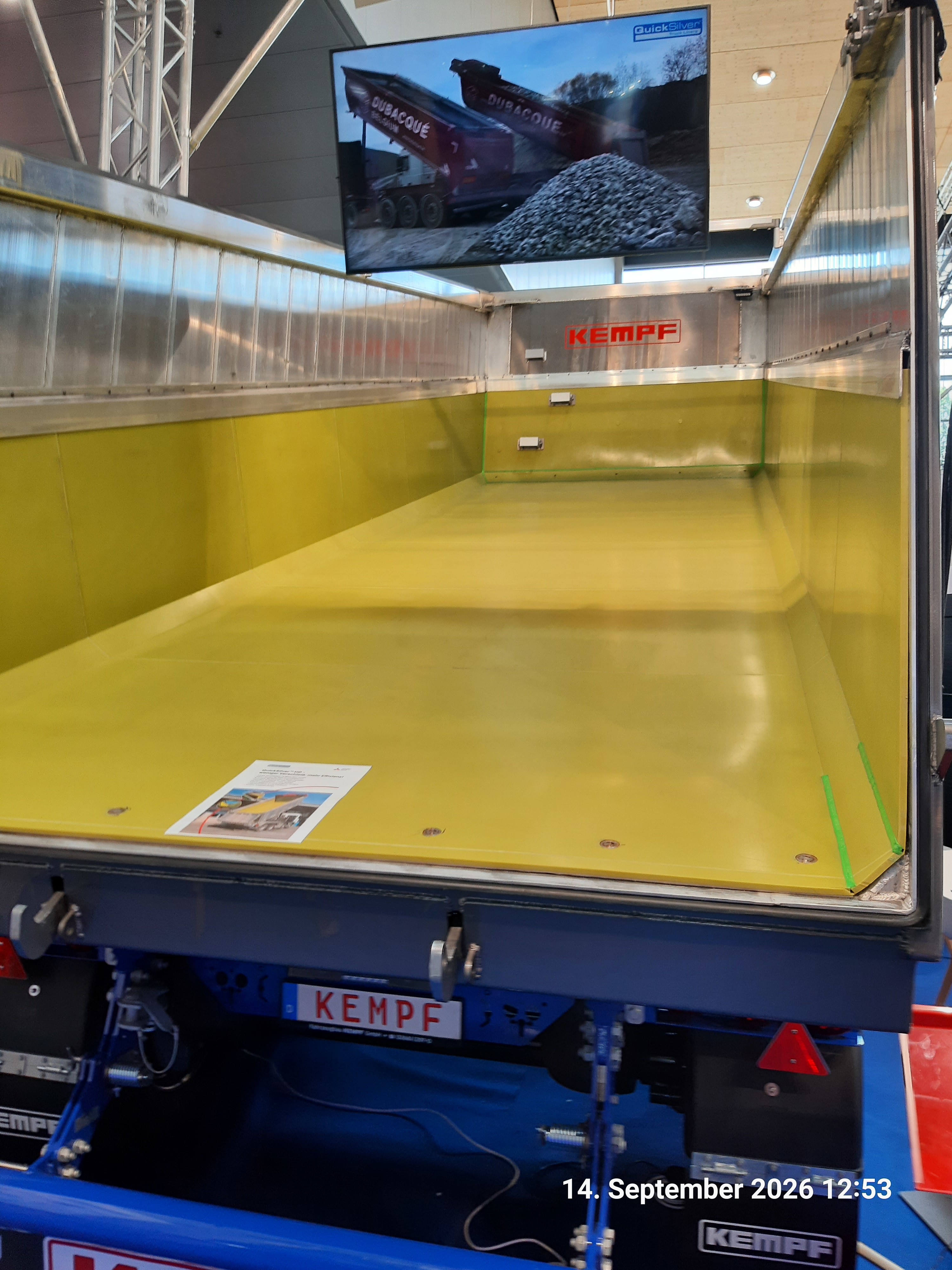
This ultra-high-molecular-weight polyethylene is suitable for many materials:
- Asphalt (except in a thermal trough)
- Clay
- Coal
- Fly ash
- Gravel
- Gypsum
- Limestone
- Salt
- Sand
- Mud and topsoil
And considering that a new trough is not exactly cheap, this is an option to save costs.
Another thing I noticed while wandering through the halls: a thermoplane for refrigerated/parcel trailers.
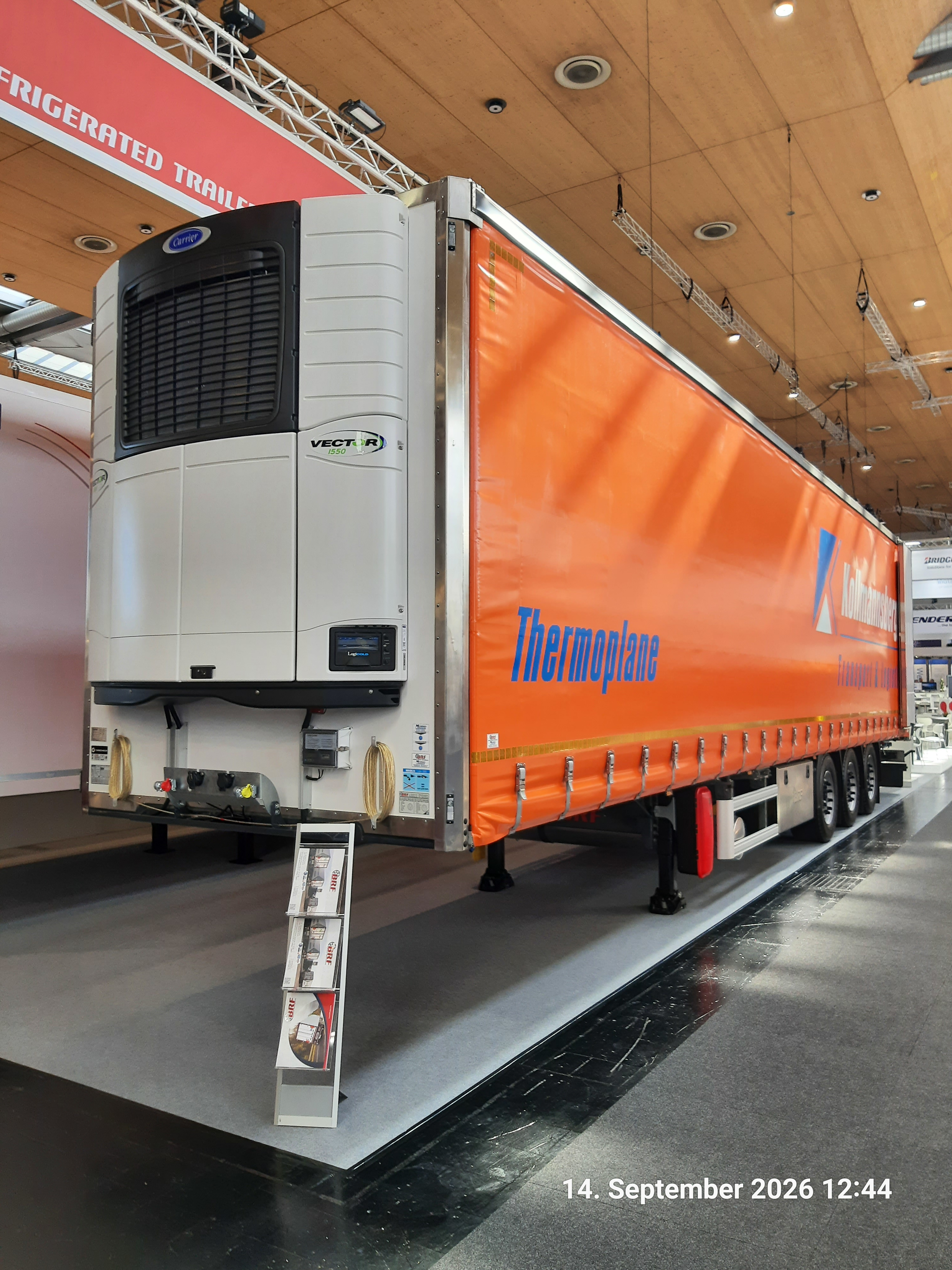
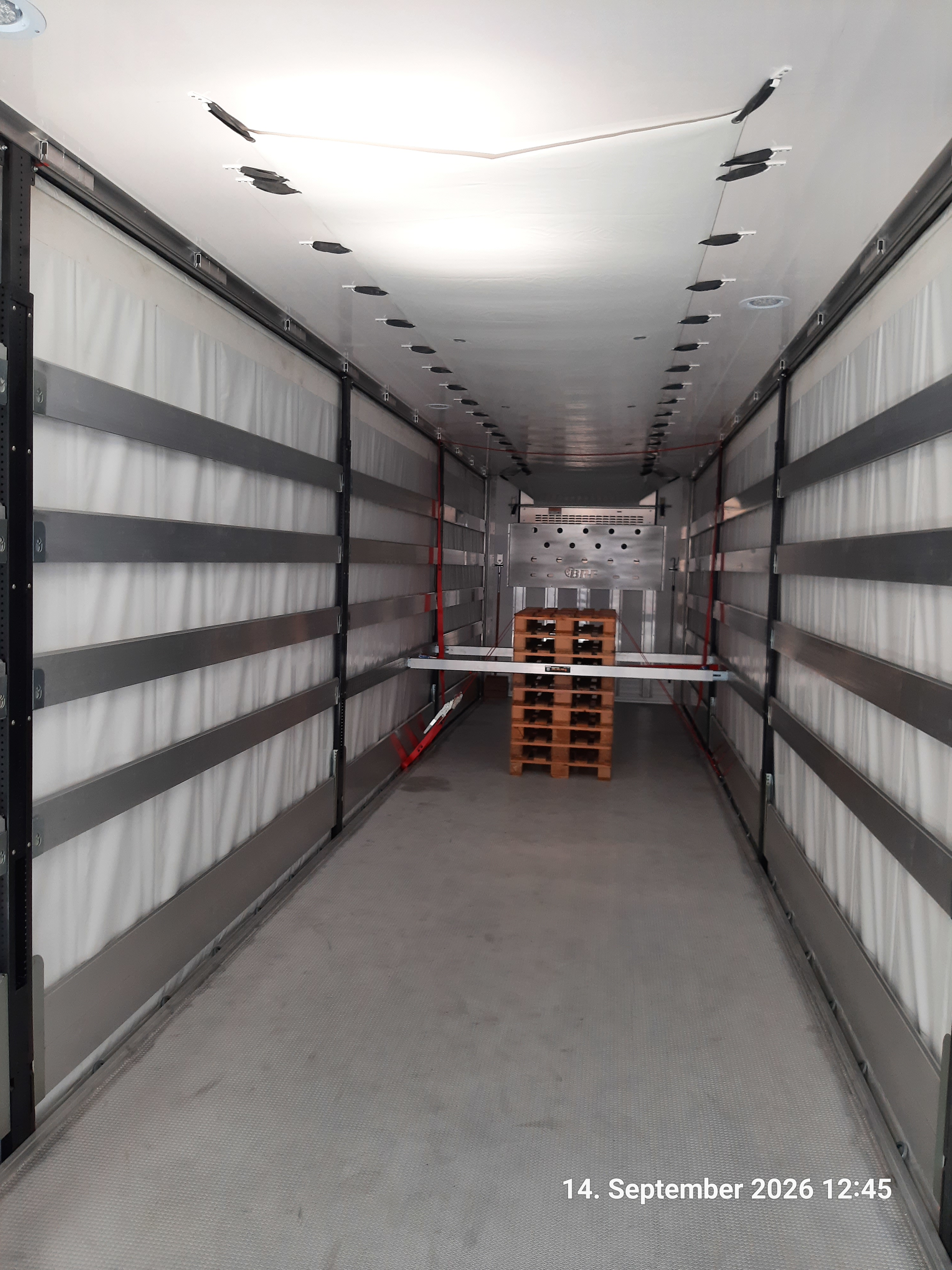
The concept itself is quite interesting, but I see problems regarding cargo theft here. Unfortunately, I could not get a conversation with the person responsible for the stand, because A) only one person was present and B) it was more important to them to get the TV at the stand running than to answer press questions. A pity actually.
Scania
Scania is represented at the IAA Transportation with two stands: once in Hall 21 and once in the outdoor area.
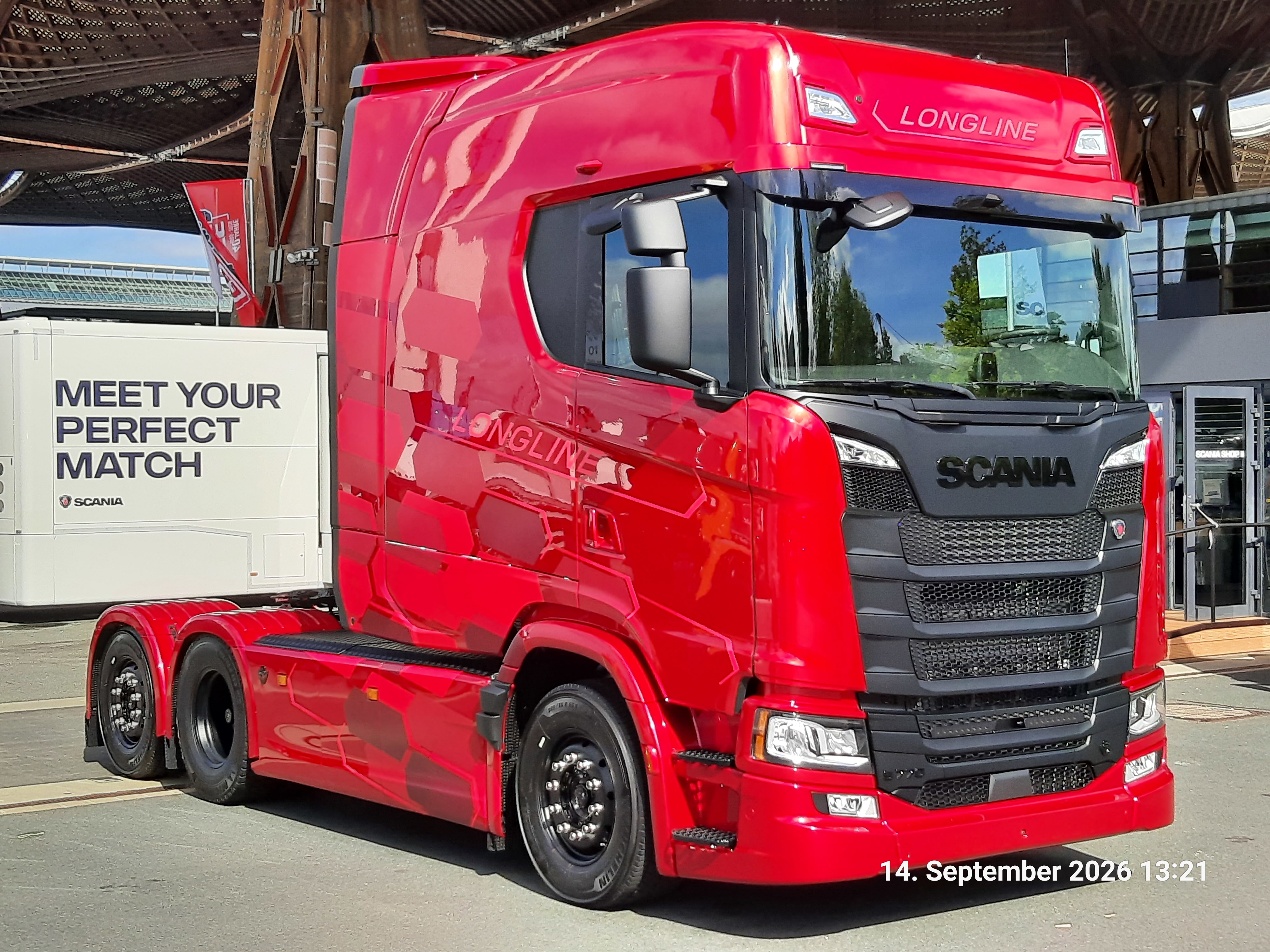
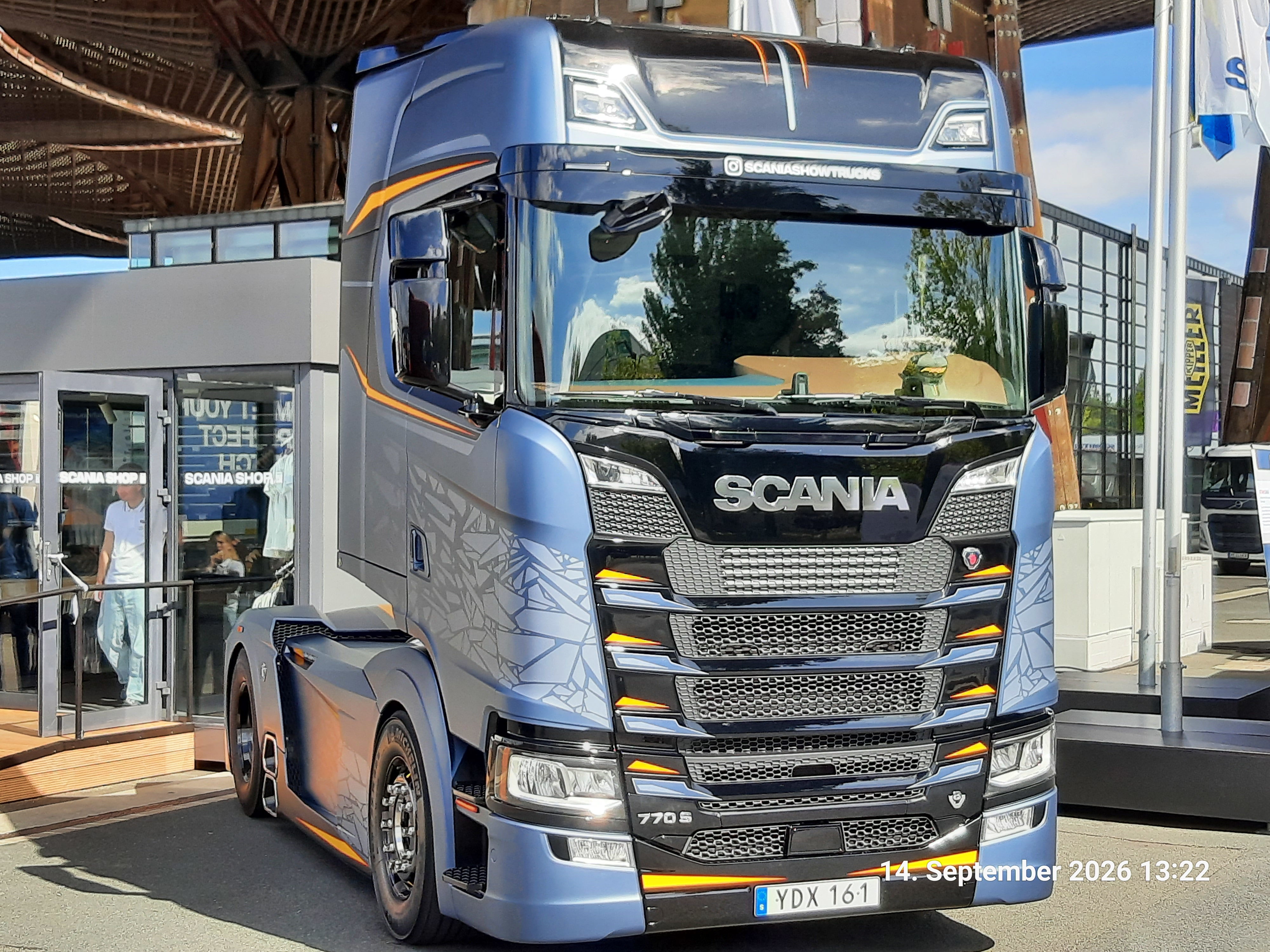
In the outdoor area, the new version of the Scania LongLine can be inspected. Right next to it stands the Frostfire Edition – a Scania 770 S, at which one immediately recognizes that this is not necessarily an off-the-shelf truck.
The Frostfire Edition was built to present Scania’s new V8 engine platform. The new V8 generation should enable cleaner exhaust gases and lower emissions without compromising on performance. Currently, the V8 is available with 530, 590, 660, and 770 hp.
And with a 770 S, one probably doesn’t need to explain for long why Scania chose this engine specifically for such a show truck. 😉
A real novelty at this year’s IAA is the Scania Dynamic. While Scania in 2024 focused mainly on its various powertrain concepts with the “Future Energy Hub,” this time it is about further development of the well-known R and S series. The new Dynamic is intended to become not only more aerodynamic and efficient but also to further improve the driver’s workplace.
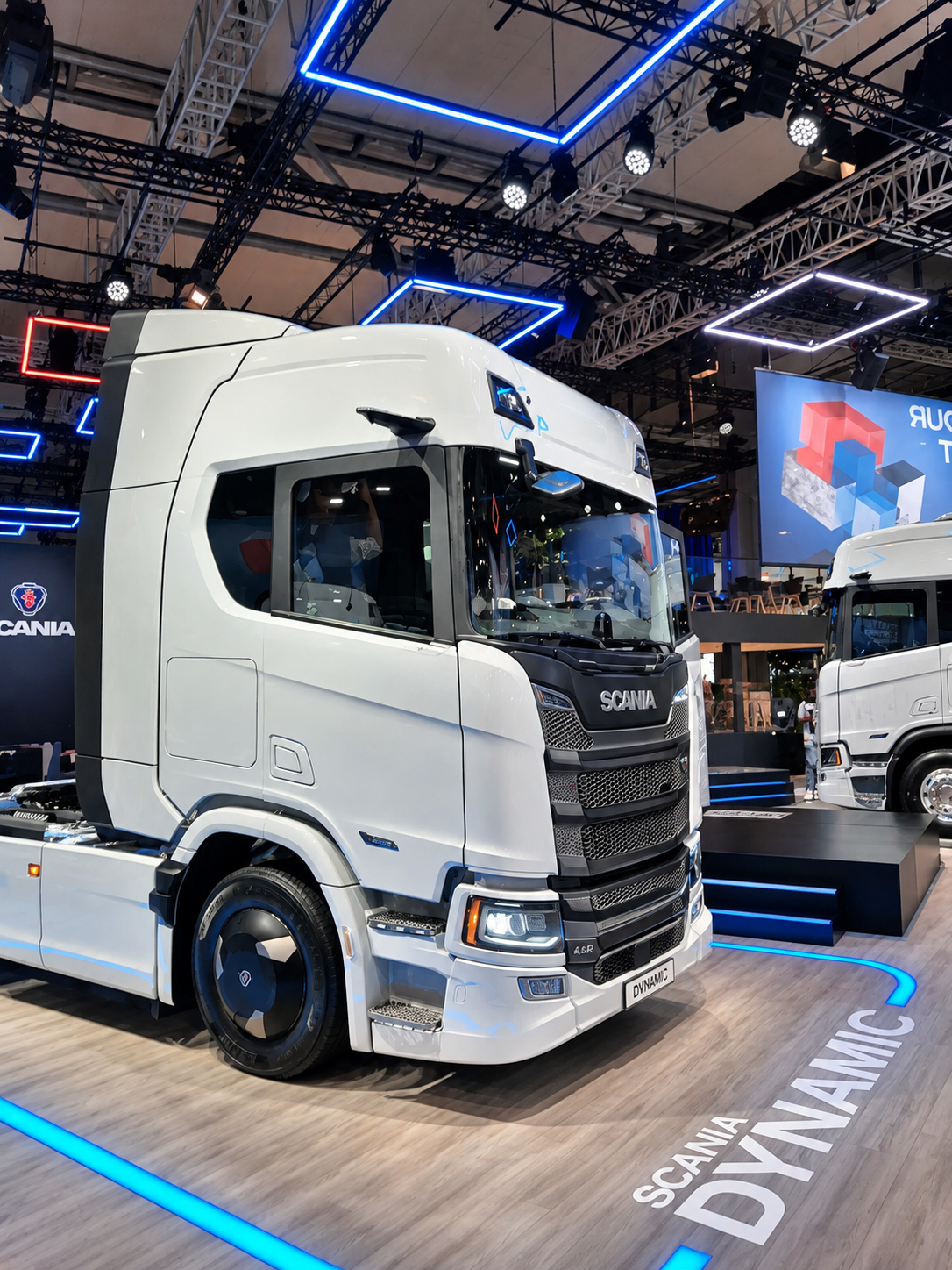
And at Scania, cameras have finally found their way onto vehicles – classic side mirrors are increasingly facing competition.
With the new Dynamic, Scania is now following suit with digital side mirrors. Thus, large European truck manufacturers now offer camera systems as an alternative to classic side mirrors.
Whether one will be required to travel with cameras in the future at Scania is, however, another question. Conventional mirrors remain part of the offering according to current status – digital rearview mirrors are added as an additional equipment variant.
And by the way, at the stand in the outdoor area is also the Scania Shop. There, once again this year, a limited special model of 400 pieces can be purchased. I already have mine 😉
Perhaps something will emerge here yet
Highlight No. 2
I had another interesting contact with ElectroFleet.
For those who cannot figure out the name so far: ElectroFleet deals with the electrification of logistics and, in particular, with charging infrastructure for electric trucks. The company plans, finances, builds, and operates charging infrastructure and energy supply for fleets. This is not just about individual charging stations, but about the complete package – from grid connection through transformers and charging points to photovoltaics, battery storage, and operation of the infrastructure.
I particularly appreciated the approach of not simply setting up a charging park somewhere and then hoping that trucks would eventually come to it. ElectroFleet wants to know from fleet operators where charging actually needs to take place and intends to consider this information when planning further locations. At the IAA, there is even an interactive map where such demands can be entered.
And exactly there, something interesting might yet emerge.
I have already been working for some time on my own charging station map and am trying to combine as many different data sources as possible. I spoke with ElectroFleet about whether it might be possible to implement API access to their database.
If this actually comes to fruition, it could open up interesting possibilities for my map. However, what data will ultimately be available and in which form I can use it still needs to be clarified.
I don’t want to make too many promises just yet. For now, let’s see what comes of the conversation. 😉
One Vehicle, Many Uses
At first, when I saw MeVe’s vehicle, I honestly thought: What is that? 😄 The look with the winch, large tires, and off-road build already makes quite an impression.
Behind the vehicle, however, lies a genuinely interesting concept. MeVe relies on a modular vehicle with interchangeable superstructures. The actual vehicle consists of the compact chassis with the cab. The rear superstructure can be exchanged depending on the intended use.
And it is exactly here that the concept becomes interesting: Instead of having a separate vehicle for each application, the same base vehicle can be used with different superstructures. MeVe demonstrates solutions for mail and parcel transport, dump trucks, municipal tasks, and waste disposal. An airport shuttle also belongs to the presented concept.
At the IAA, the OFF-R with its quite martial off-road build was at the center of attention. But actually, it is not the superstructure that is fascinating, but what lies underneath: a vehicle that can adapt to different tasks by changing the superstructure.
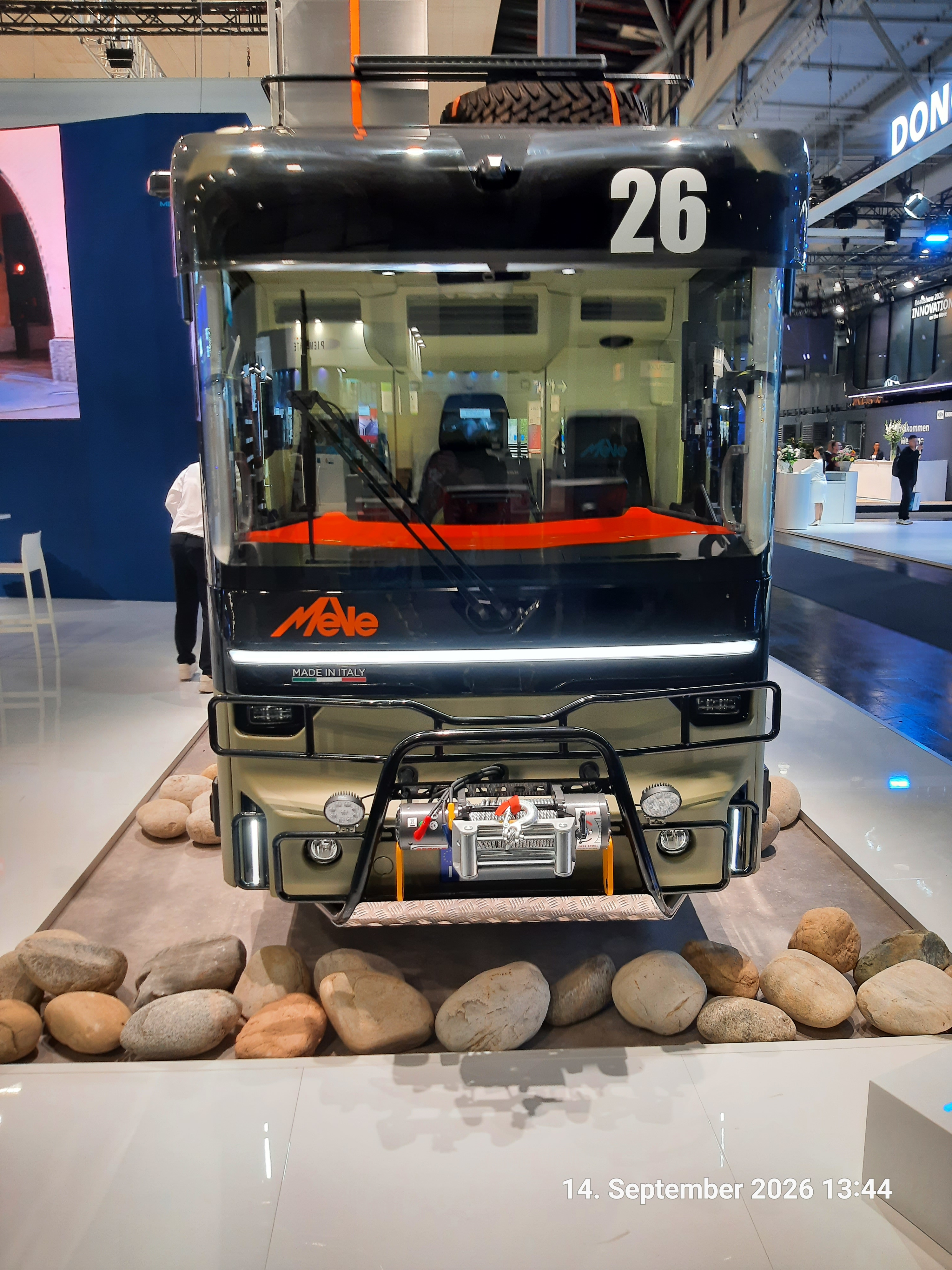
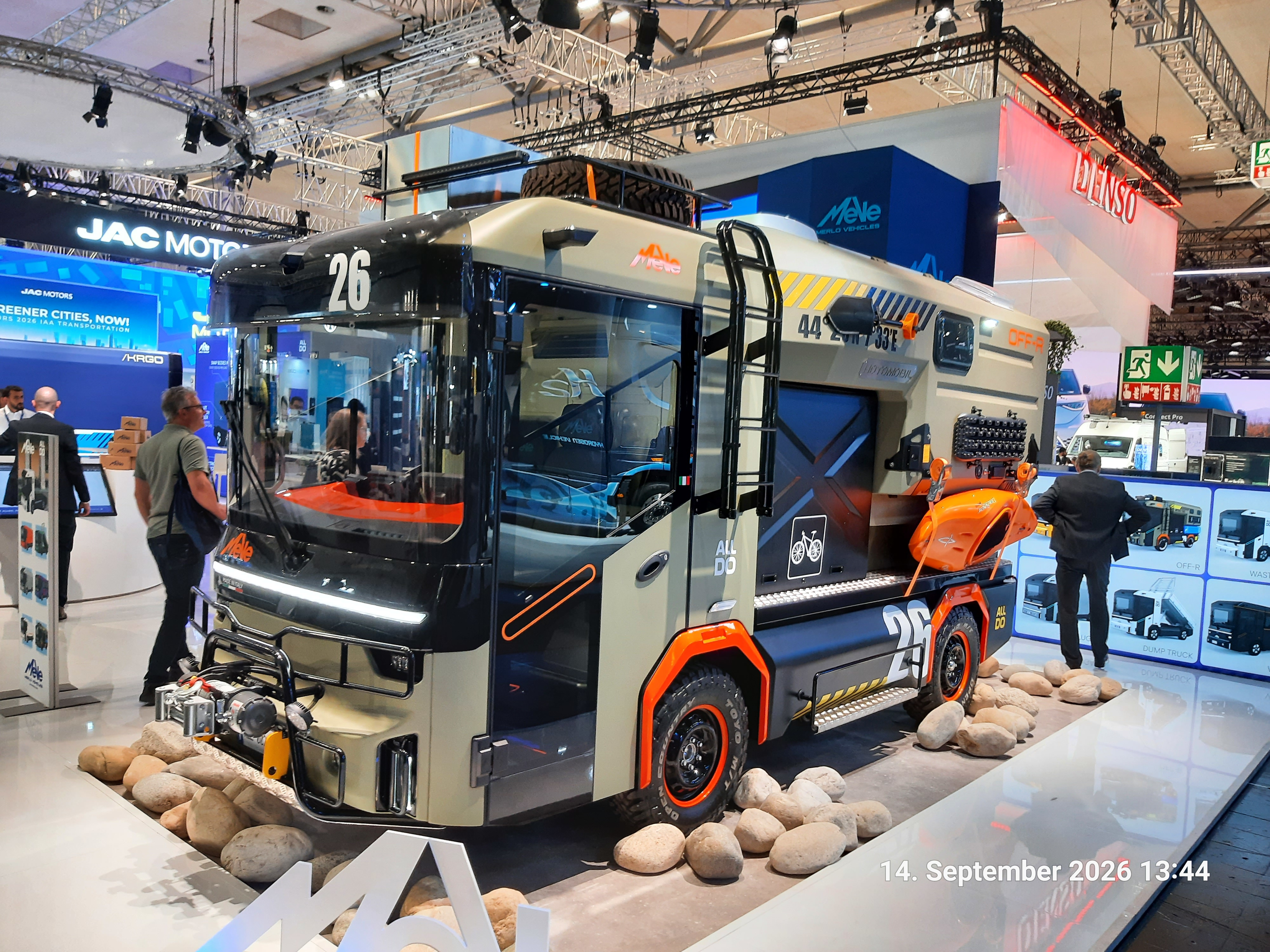
Such a concept could be quite interesting for municipal or urban applications. One vehicle – multiple areas of application and accordingly fewer vehicles in the fleet that are specifically bound to certain tasks.
To Conclude This Article
One can also say here again: The IAA is electrified.
With the difference that, after my one-time break from the IAA in 2024, I now have a much stronger impression that Asians are on the advance in the European commercial vehicle market.
And what strikes me: The vehicles by no way give the impression of cheap Chinese goods. And certainly not does it create the impression in me: “This is all just stolen.” Especially considering how Asians crawled into every tiny “hole” at the fair in 2016 and even still in 2018 that one could find on a truck, where one actually thought: No human would ever fit there. 😄
I see it myself with my own passenger car. The processing of materials is decent, the gaps fit, and even when looking at details, nothing can be found that one would spontaneously say: “This trash you buy at Temu.” 😉
On the contrary.
The test drive with the SuperPanther eTopas 600 showed me that the Chinese are now showing quite clearly what they can do in the passenger car sector. Also, in commercial vehicles, there are vehicles coming to market that one should take seriously as a European manufacturer or, better said: One could cut off a slice of the pie.
Because what I noticed with the Chinese vehicles is: Much that one knows at least partially as optional equipment from established manufacturers apparently already belongs to the standard range there. So you get quite a lot for your money – and ultimately, the driver also benefits from this.
And perhaps something more at the end, which might make some ask now:
What does that have to do with commercial vehicles?
But the explanation for that is actually quite simple.
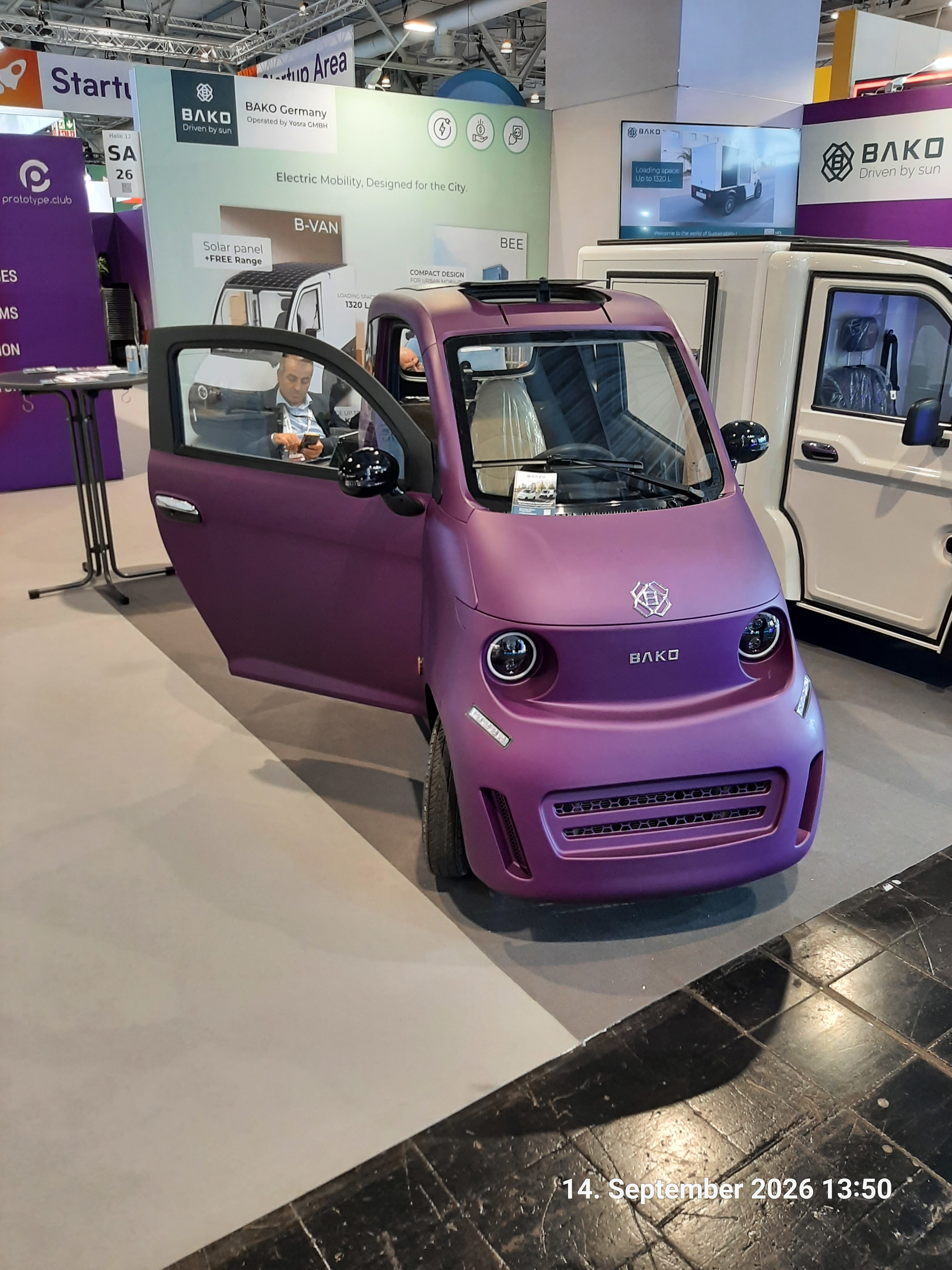
During my tour of the IAA, I also stumbled upon BAKO . At first glance, the vehicles look a bit like a very small electric transporter – and exactly that they are. However, there is a somewhat different concept behind it.
BAKO Motors is originally a Tunisian company specializing in small electric vehicles for urban mobility and so-called last-mile delivery. What I find particularly interesting is the idea of generating part of the required energy directly via solar cells on the vehicle itself.
At the fair stand, among other things, the B-VAN was displayed. It is truly tiny with a length of just under 2.82 meters and a width of only 1.24 meters. Up to 1,320 liters of cargo should fit inside, and depending on the version, up to 400 kilograms of payload are possible.
Of course, this is not a vehicle for classic parcel delivery with 200 stops and certainly not a replacement for a Sprinter. But for short delivery routes in inner cities, on company grounds, or for other applications where speed and range do not necessarily take center stage, I find the approach quite exciting.
Especially the combination of a small electric vehicle and its own solar energy could be interesting in places where vehicles are out all day and then stand for longer periods again.
And exactly for that reason, such a small vehicle also belongs on a commercial vehicle fair, in my opinion.
After all, commercial vehicles don’t always have to move 40 tonnes. Sometimes it’s simply about getting as much work done with as little vehicle as possible.
As I wrote in the article, I didn’t manage to cover everything chronologically yesterday. For instance, I wasn’t at MAN, but I will make up for it on Saturday when I’m at the fair with my children, fitting perfectly with Family Day.
This year again, people often heard from smaller booths: “Finally, someone is coming by!” Even late in the day, I was frequently the first to actually look at a booth.
Saturday Update
Today I was back at the IAA. I chatted briefly with Jörg Schwerdtfeger and naturally posed for a few photos too. 😄
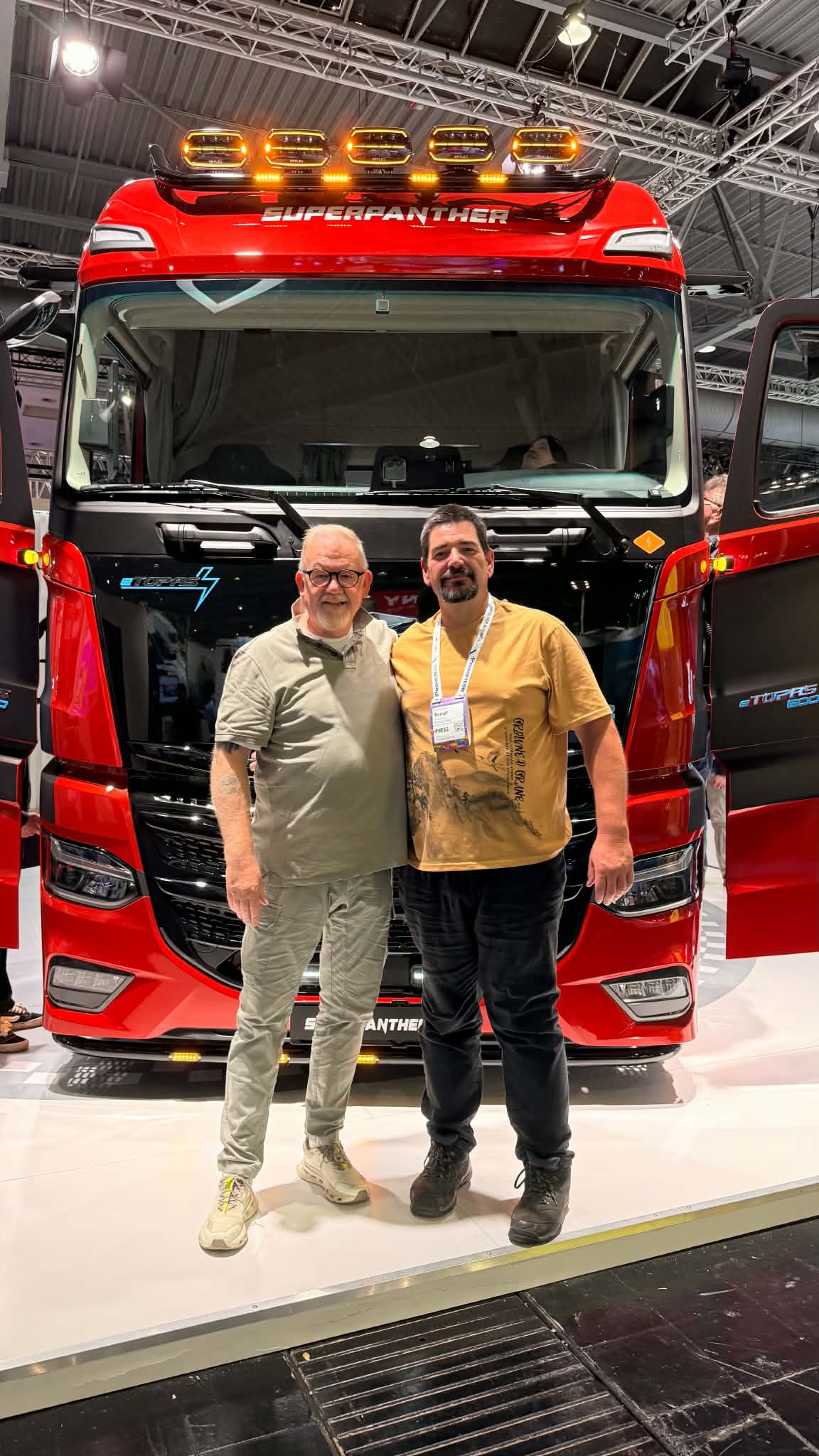
Naturally, without taking another look at the Superpanther eTopas 600.
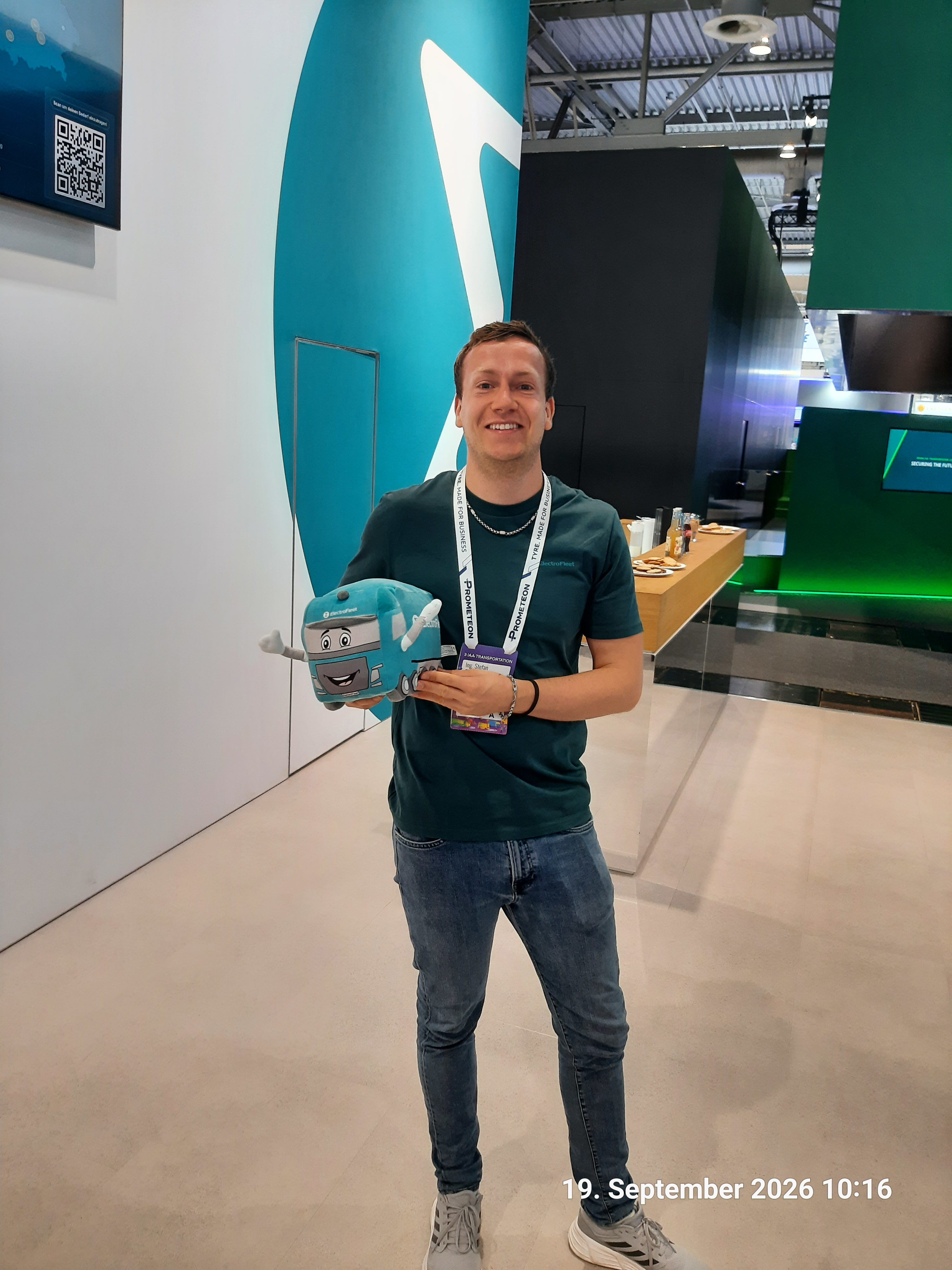
After that, I stopped by ElectroFleet again. Stefan Schmitz was able to give me some information about the planned opening of the charging park in Osnabrück. If everything goes according to plan, it should be ready by the end of October.
All in all, the fair was interesting again today. However, some drivers unfortunately showed their “best” side once more.
Of course, one can be critical of foreign vehicle manufacturers. One can find certain vehicles good or bad and discuss whether one trusts a manufacturer from China, Sweden, Germany, or elsewhere.
What I don’t understand, however: Why must exhibition vehicles be treated in such a way that they eventually actually break down?
An example caught my eye today at the BYD booth. Someone moving around inside the cab and causing the truck to sway a bit – granted, that’s what vehicles are for. But knocking on instruments, forcibly pushing the driver’s seat all the way back, and then making remarks like “This won’t last long” – I honestly don’t understand that.
If exhibition vehicles are treated this way, it’s no great surprise when something eventually breaks down. With the behavior I observed today, it would almost be a miracle if one could still look inside undamaged trucks at a fair in two years.
And no, one doesn’t have to subject a truck to arbitrary stress tests just because it’s on display. The BYD ETT44 achieved five stars in the Euro-NCAP test and is approved for the European market. The vehicle must therefore be able to withstand quite a bit.
Still, an exhibition vehicle is not a toy. A little experimentation is perfectly fine. But there is a rather clear difference between “I’m checking out how it feels” and “I’m thrashing around on the vehicle until something gives way.”
MONTX P10 and V10 – two quite unusual concepts
At GAC Commercial Vehicle, besides the actual commercial vehicles, there were also two vehicles that definitely required a second look: the MONTX P10 and the MONTX V10.
The P10 is clearly designed for adventure and difficult terrain. Four separately driven electric motors, an adaptive suspension design, and various technologies for off-road use are supposed to take it forward even where a normal pickup would eventually give up. And then there’s the aircraft on the cargo bed – MONTX is indeed thinking about a combination of ground and air mobility here.
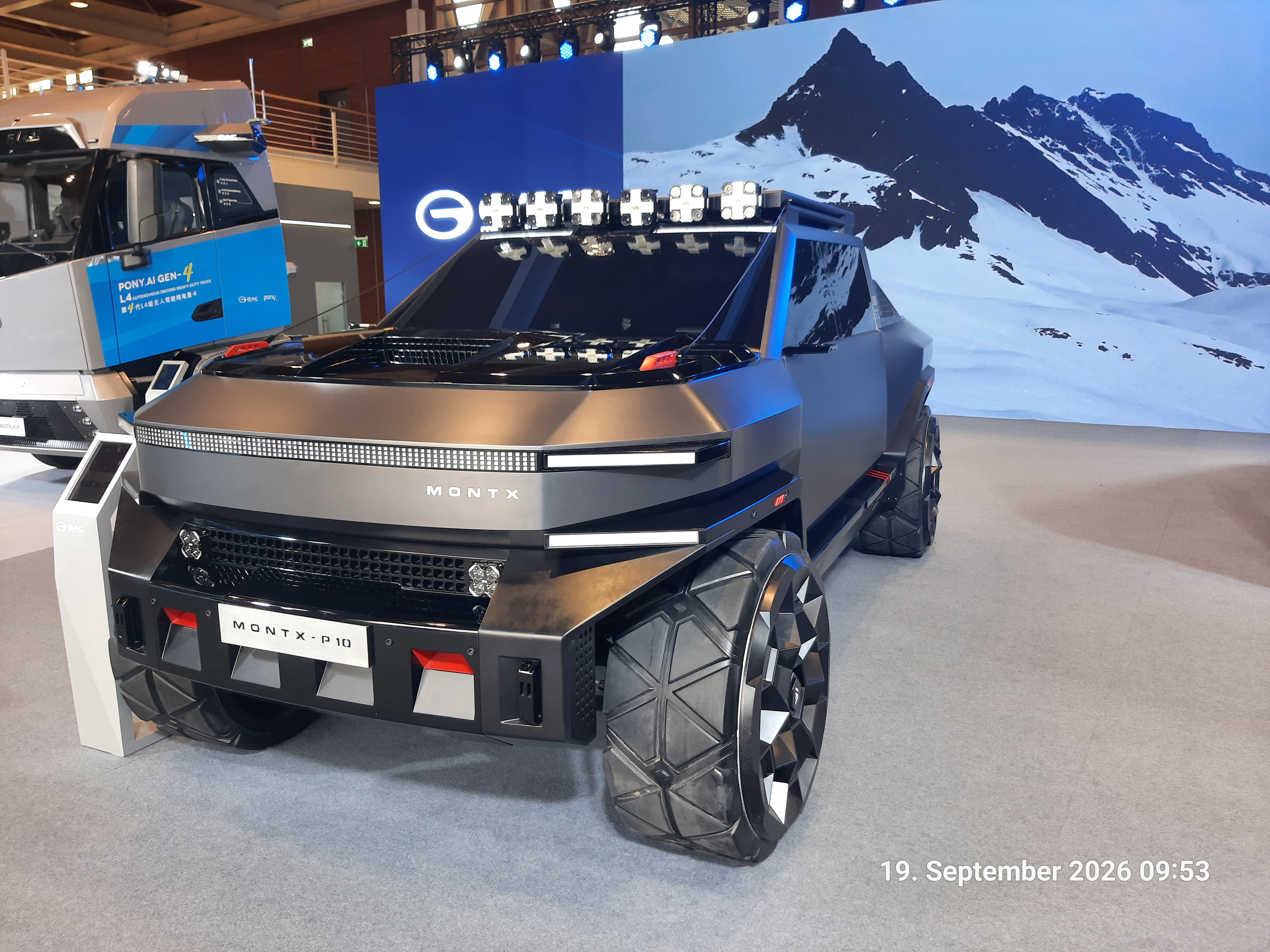
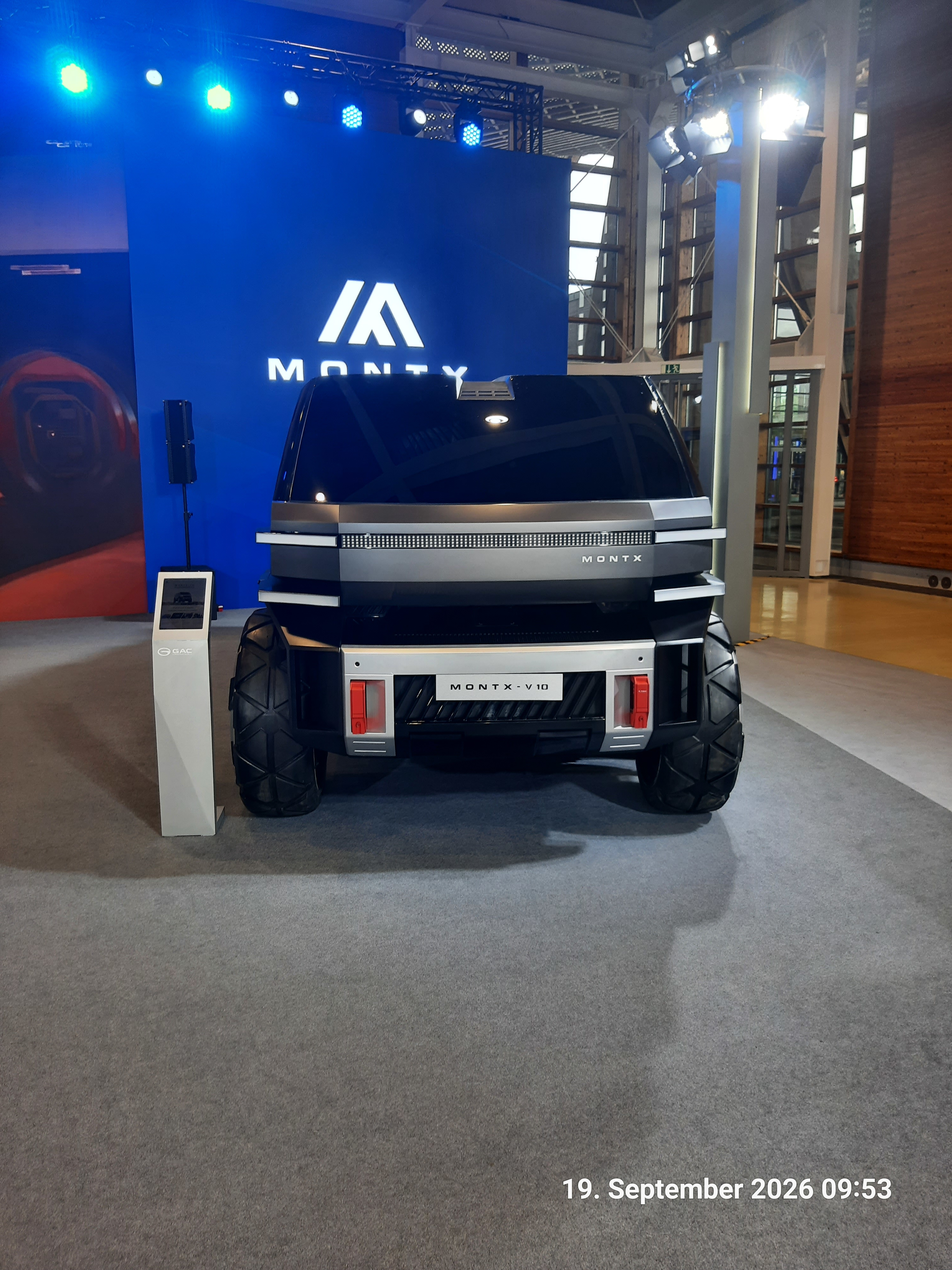
Right next to it stood the V10. It pursues a completely different approach. MONTX describes it as an “All-Domain Mobile Station.” Instead of expedition, mobile work and living are at the center here. The interior is modularly constructed and should be able to adapt to different situations. In addition, there is an autonomous energy supply for operation off the power grid.
Both vehicles are concept vehicles and not imminent series models. MONTX uses them rather to show what the new brand envisions for future mobility in the commercial vehicle sector. At the IAA, one thing was particularly noticeable: GAC apparently no longer thinks of a commercial vehicle solely in terms of transport and cargo, but is trying to combine vehicle, workplace, leisure, and digital technology.
Unfortunately, one couldn’t take a look inside. A pity actually.
Let’s see what new things come from the Far East in two years.
For me, it’s certainly clear: it was worth it. Also because I could test drive the Superpanther and received plenty of information.
One thing is certain: The future is definitely electric and partly also autonomous.
