

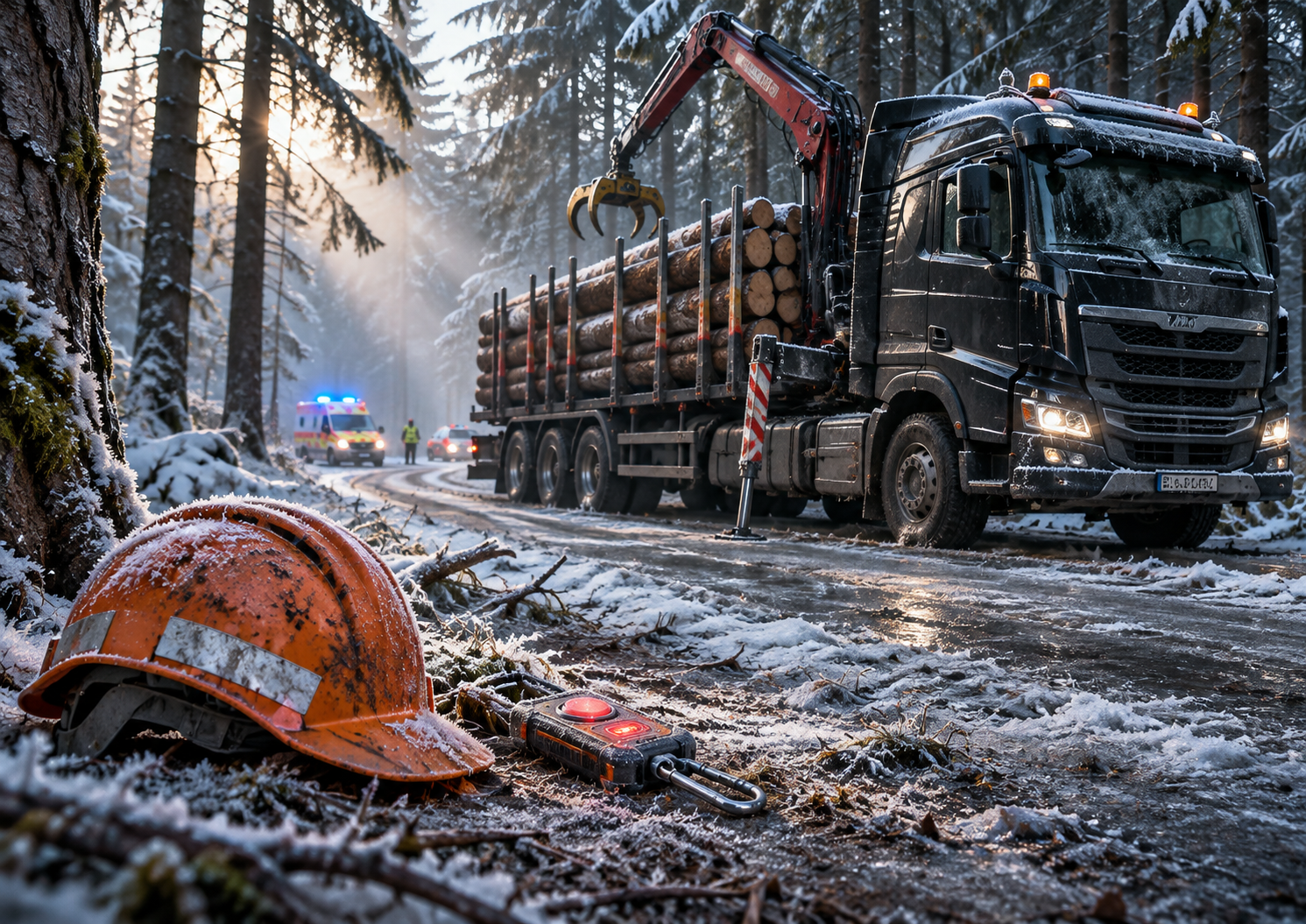
GPS tracking is often presented as a safety benefit in road haulage. But what good is it if the transport office knows where the lorry is and nobody notices that the driver has had a serious accident? Systems that go beyond vehicle tracking already exist. We should be talking about them, especially where people do hazardous work alone.
An accident I won’t forget
About five years ago I fell off a loader crane at work.
I was out in the woods with my lorry as usual. I landed on my back on the frozen forest floor. Three spinous processes in my spine broke, and I was off work for nearly six weeks.
Anyone who’s had an accident like that can imagine the pain. Aside from the injuries, I had another problem. I was alone.
My phone was in the cab. I couldn’t stay where I was and call for help. In spite of my injuries, I had to drag myself back into the lorry somehow so I could call from there.
It could have ended very differently.
What if I’d lost consciousness? What if I hadn’t been able to move at all? There was a tree stump right beside me. Had I landed on it, my spine would have been done for. I wouldn’t have been able to climb into the lorry and reach my phone.
For me, that’s where a conversation begins that we have far too rarely in road haulage.
GPS tracking can save lives, with limits
I recently read a Facebook post describing how GPS tracking on lorries could save lives.
The author said that drivers who had suffered medical emergencies had been found through GPS tracking and treated in time.
I don’t dispute that. Of course it helps if a company knows a vehicle’s last reported location.
There are two very different things at issue here.
Locating a vehicle and detecting an injured person are separate tasks.
Most telematics systems record vehicle locations, driving time, time spent stationary and, depending on the equipment, other operating data.
They generally can’t detect a driver lying injured on the ground a few metres from the vehicle.
That’s the problem.
If you imagine someone at a haulage company constantly watching every vehicle on a screen and raising the alarm the moment it stands still for a while, take a look at a typical day in a transport office.
Staff plan routes, co-ordinate appointments, keep customers informed and sort out problems. Vehicle locations are only part of the job. And there are plenty of ordinary reasons why a lorry might sit still for some time.
One driver’s waiting to unload. Another’s on a break. Another’s at a customer’s premises. And I need time in the woods to load my logs.
Even if someone regularly checked every stationary vehicle, they couldn’t reliably tell from that whether a driver was working or injured.
In my case, GPS tracking might have shown my lorry parked in the woods. On its own, that would have looked perfectly ordinary.
Technology that can detect a worker in distress
What surprises me about this debate is that we’ve long had technology that can detect emergencies much more directly.
Some of these systems have been used for years in jobs that involve working alone.
Examples include maintenance, field service and certain forestry work.
They are known as personal emergency alarm systems, or PNA in German.
The principle is straightforward.
The worker wears a dedicated device. It may have an emergency button they can press to call for help.
The automatic functions are particularly interesting.
Depending on the device, it can detect if the wearer stays still for a set period, ends up in an unusual position or fails to check in at an agreed time.
It can then send an alert to a monitoring centre.
The German Social Accident Insurance (DGUV) distinguishes between manually and automatically triggered alarms.
A manual alarm means I press a button myself.
An automatic alarm means the device triggers when a preset condition is met, even if I’m unable to activate it myself.
That could have made a real difference in my accident.
A suitable wearable device might have detected that I’d fallen or wasn’t moving enough afterwards.
Looking back, there’s no way to tell whether it would have picked up my particular accident. That depends on the device and its settings.
At least there would have been a way to raise the alarm without me having to make the call myself.
Ordinary vehicle tracking generally can’t do that.
What about a smartwatch?
Consumer equipment has come a long way too.
Some modern smartwatches have automatic fall detection.
Supported Apple Watch models, for example, can try to contact the emergency services if they detect a hard fall and the wearer doesn’t respond.
The watch can also share location data.
It won’t work in every situation.
Some falls go undetected. The feature has to be set up correctly and needs a suitable connection.
The Apple Watch Ultra 3 is particularly interesting here. It also supports Emergency SOS via satellite in Germany. In certain conditions, after detecting a hard fall, it can automatically try to send an emergency message by satellite if mobile coverage and Wi-Fi are unavailable.
That sounds promising for a timber lorry driver.
There’s a catch. Satellite communication needs as clear a view of the sky as possible.
Anyone who’s worked in the middle of a dense stand of spruce knows you can’t count on that everywhere.
A smartwatch can offer an extra layer of personal protection. Whether it is suitable as a workplace lone-worker alarm is a separate question.
Why ordinary haulage can be dangerous too
You don’t have to operate a loader crane in the woods to find yourself in danger while working alone.
Take an ordinary articulated lorry.
A driver stops in a remote parking area in the evening to check the load and falls off the load bed.
Or they pull back a curtain at a customer’s premises and get struck by a piece of cargo that has shifted.
They might be working alone on a tail lift, lose their balance and hit their head.
There can also be serious falls getting into or out of the cab.
How does vehicle tracking help in those situations?
The transport office might know where the lorry is. At first, that’s all they know.
A suitable personal alarm worn on the body could automatically raise the alarm when it detects certain signs of an accident.
There are simpler measures, of course.
You can agree regular check-ins. For instance, the driver can report back after a particular task. If they don’t, someone follows up.
It costs relatively little and can make sense for suitable tasks.
The drawback is that valuable time can pass before the agreed check-in.
When a driver urgently needs medical help, even a few minutes can make a difference.
Timber haulage: when an accident happens deep in the woods
In forestry, the problem becomes more acute.
Anyone who regularly hauls logs knows the conditions. Narrow forest tracks, hard-to-find entry points and patches of poor mobile reception are part of the job.
We also use a loader crane to load the lorry. Depending on the vehicle and its equipment, the controls can be high above the ground.
That creates risks you wouldn’t normally encounter in general haulage.
As well as falling, there are hazards from moving logs, operating the crane and working on uneven ground.
A serious accident can leave the driver unable to get help.
And even if a call goes through, the emergency services still have to reach the injured person.
The lorry’s GPS co-ordinates help. An ambulance can’t use every forest track, though. The crew needs to know which access route to take and where the injured person actually is.
This is where forestry emergency rendezvous points come in.
These are designated locations that help guide emergency crews into forested areas.
Germany’s Social Insurance for Agriculture, Forestry and Horticulture (SVLFG) specifically recommends planning the emergency response before work starts.
An emergency rendezvous point can serve as a meeting place from which someone guides the crew to the accident site.
You can’t assume every point will be signposted or easy to reach from wherever you’re working.
The arrangements need to be in place before anyone is lying injured on the ground.
What about satellite emergency devices?
Several satellite emergency devices are now available for areas without mobile coverage.
Garmin’s inReach range is one example.
These devices can send an SOS by satellite. Since October 2026, Garmin’s ‘Free SOS’ feature has allowed supported models to send an SOS even while the subscription is paused.
That’s a useful addition in the woods.
It has limits too.
On the inReach devices mentioned here, you have to trigger the SOS yourself. You can’t do that if you’re unconscious.
A satellite device also needs a good enough connection to the satellite. Dense tree cover or difficult terrain can interfere with it.
A satellite emergency device is especially useful if you can still act but have no mobile signal.
It won’t automatically get help for an unconscious driver.
What would work for general haulage and timber haulage firms?
I wouldn’t settle this question by picking a single gadget.
What matters is how quickly someone detects an emergency and whether help actually reaches the driver.
Depending on the risks, scheduled check-ins and a suitable personal alarm could already offer useful protection in general haulage.
When workers regularly do hazardous tasks alone, the company needs to assess whether a personal emergency alarm system is necessary.
In forestry, I’d go a step further.
A risk assessment should address these questions in particular:
- Can the driver call for help after an accident, or could they lose consciousness or be unable to move?
- Is there adequate mobile coverage at the work site, and how will a lost connection be detected?
- Can a wearable device automatically call for help when it detects a relevant alarm condition?
- Who receives the alarm, including outside normal office hours?
- How will emergency crews find the actual accident site, and which forest tracks can they use?
- Is the task suitable for lone working in the first place?
That last point is particularly important.
Fitting an emergency alarm doesn’t automatically make it permissible to do any hazardous job alone.
Some forestry tasks, such as felling trees by hand or working with a chainsaw, are subject to particularly strict requirements. The SVLFG says several kinds of hazardous lone working are generally prohibited.
For a timber lorry driver working alone, the employer needs to assess the specific hazards of the job.
An emergency alarm can’t take the place of safe working practices or the required protection against falls and other accidents.
What do the health and safety rules say?
This goes beyond what employers choose to do for their staff.
Under section 8(2) of DGUV Regulation 1, an employer must provide suitable technical or organisational measures to protect workers doing hazardous work alone, on top of the general safeguards.
DGUV Rule 112-139 describes how to assess hazardous lone-working situations and what to take into account when using personal emergency alarm systems.
There is no blanket requirement for every lorry driver to wear an electronic fall detector.
Companies do have to identify existing hazards and decide what measures are suitable.
I’d like to know how many haulage companies actually look at this.
GPS tracking is now routine in many fleets.
When they introduce it, do they routinely ask what protection a driver has if they suffer a serious accident while loading alone?
I doubt that question gets the same attention everywhere as driving hours, vehicle locations or route planning.
I don’t have reliable figures on it, though.
Protecting workers without expanding surveillance
There’s one other point I want to make.
A personal emergency alarm system shouldn’t be used to monitor employees more closely.
Whether a driver takes an extra five minutes on a break or where they spend their working hours is beside the point.
The purpose is to detect a serious emergency and start getting help to the driver.
That may require sharing their location. There isn’t necessarily any need to retain a complete history of their movements.
What data can be processed depends on the specific system and its purpose. This includes checking data protection requirements and, where relevant, the works council’s participation rights.
A well-designed emergency alarm system should therefore collect as little data as possible.
Safety and data protection can go hand in hand.
They just need to be considered together from the start.
Looking ahead: could 6G sensing detect accidents?
Alongside the emergency alarm systems already available, researchers are working on a technology that might offer further options: 6G sensing.
It uses radio waves for communication and also to pick up motion and changes in the surroundings. Under the right conditions, it could detect someone even if they weren’t carrying a smartphone or any other electronic device.
Applied to my accident, that could be interesting.
A system equipped for sensing might detect someone suddenly falling from a loader crane and then lying motionless on the ground. In theory, this could trigger an automatic alert.
These applications are still at the research stage. Remote forests pose particular challenges, including a lack of wireless infrastructure, the terrain and the vegetation.
For now, suitable personal emergency alarm systems and a workable emergency response plan are still crucial.
The technology has a downside as well. The same technique that could detect an accident might also be used to monitor people without their knowledge.
I explain what 6G sensing could do, how it works and what it means for privacy in ‘6G sensing: when the mobile network detects you, even without a smartphone’ .
My accident could have ended differently
When I think back to that fall, I’m glad I still managed to make it to the cab in spite of my injuries.
Three broken spinous processes were bad enough.
I don’t want to imagine what would have happened if I’d lost consciousness or been unable to move.
There might have been an injured driver lying in the middle of the woods.
And on a screen somewhere in the transport office, there would have been a lorry that hadn’t moved for a while.
That alone wouldn’t have raised an alarm.
I have no objection to GPS tracking in principle, provided it’s used sensibly and respects workers’ rights.
It can help with route planning and provide vital location information in an emergency.
A system that protects the person has a job of its own.
Anyone serious about protecting their drivers needs to think about how an accident will be detected, how the alarm will be raised and how quickly someone can actually help.
That has to work even when the driver can no longer speak or use a phone.
What matters when I need help is that someone notices. Knowing where my lorry is only gets you so far.
Sources and further reading
- DGUV Regulation 1, section 8: Hazardous work
- DGUV Rule 112-139: Use of personal emergency alarm systems
- DGUV Information 212-139: Emergency call options for lone workers
- DGUV: Frequently asked questions about personal emergency alarm systems
- SVLFG: Forestry emergency rendezvous points
- BG Verkehr: Safety when loading and unloading
- Apple: Fall Detection on Apple Watch
- Apple: Emergency SOS via satellite on Apple Watch Ultra 3
- Garmin: Free SOS, satellite emergency calls without an active subscription
As at 7 November 2026
Author: Christian Rumpf – ChristiansBlog.eu