

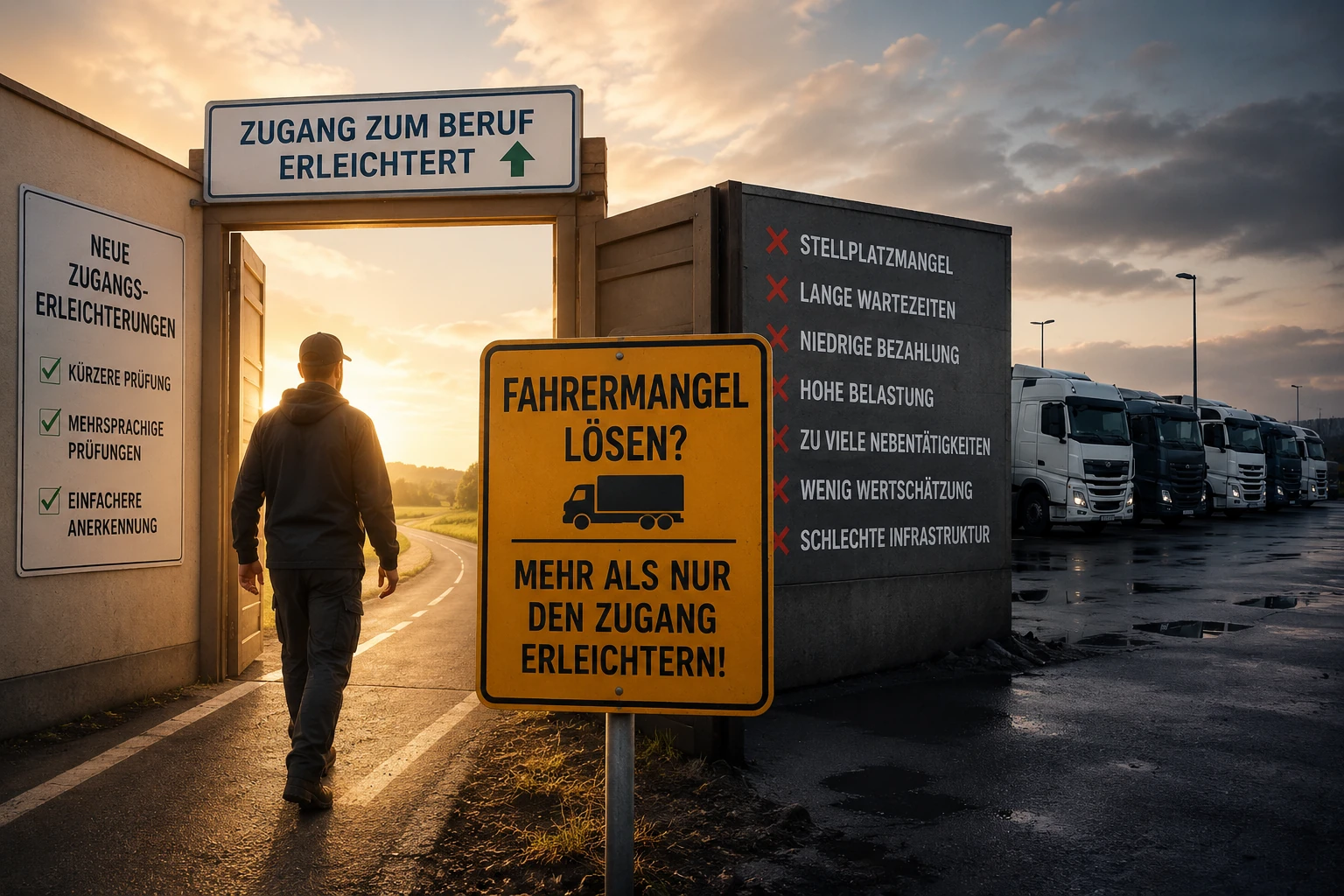
New rules for access to the profession of professional driver take effect today. The federal government aims to address one of the well-known causes of the driver shortage: it is intended to make qualifying people for the profession easier and faster.
This sounds reasonable at first glance.
The practical examination for the basic qualification will be shortened, the accelerated basic qualification exam can now be taken in additional languages, and there are also facilitations regarding the recognition of certain foreign driving licenses.
The corresponding amendment regulation was promulgated in the Federal Law Gazette on August 17, 2026, and has been in force since August 18, with the exception of one individual part.
However, despite all the joy over less bureaucracy, there remains for me a crucial question:
Are we actually solving the driver shortage with this – or are we merely ensuring that new drivers come through a door faster, while at the same time doing almost nothing to change why others go back out through the same door?
What is concretely changing now
First of all, one should not downplay the changes.
The examination for the accelerated basic qualification can in future be taken in nine additional languages besides German:
- Albanian
- English
- Modern Standard Arabic
- Croatian
- Polish
- Romanian
- Russian
- Turkish
- Ukrainian
Interestingly, there is even a small detail: In the original press release from the Federal Ministry of Transport, mention was still made of eight foreign languages. In the now applicable regulation, there are nine, because Albanian has been added additionally.
This can particularly help people who already possess the necessary prerequisites but would have failed in an examination due to the German language of examination until now.
There are also facilitations for foreign driving licenses. Among other things, Ukraine and Montenegro have been included in the corresponding regulations of the Driving License Ordinance. Furthermore, certain third-country driving licenses exchanged in another EU member state will in future also be recognized in Germany.
And then there is also the practical examination.
The previous practical examination comprised a total of 210 minutes. In future, it will be 120 minutes. The corresponding part of the examination for “handling critical situations” is abolished; furthermore, the actual driving test is shortened from 120 to 90 minutes.
The ministry describes all of this as a reduction of access barriers and as a contribution to bringing drivers into the profession faster.
And it is exactly at this point that my criticism begins.
Because the driver shortage does not start at the entrance gate
I have already dealt with the topic of the driver shortage in more detail.
My central thesis was not that there is no problem with new recruits at all. Of course, we need new drivers. An aging professional group cannot function permanently if fewer people are coming than leaving.
The real problem, however, is that the discussion often ends exactly there:
How do we get more people into the profession?
Much less frequently is asked:
Why do people leave the profession altogether?
And it is precisely this distinction that I consider crucial.
A profession can be so easily accessible. If the conditions afterwards are not right, we may have more career starters – but no permanently solved driver shortage.
In my more detailed contribution on the driver shortage, I therefore asked exactly this question: Why do experienced professional drivers leave their profession and why would many of them not recommend this profession to their own children today?
The problem often lies not in the driving itself.
The profession is not unattractive because of the examination
Of course, an examination of 210 minutes is a burden.
Of course, taking an examination in one’s own mother tongue can be a significant relief.
And of course, it can make sense to allow qualifications and driving licenses to be recognized without unnecessary complications.
I have absolutely nothing against that.
But if we are honest, hardly anyone would say:
“I would like to become a professional driver, but the 210-minute practical examination prevents me from doing so.”
That is at least not the central problem I know from my professional daily life.
The real daily life finally begins after passing the examination.
Then one does not sit for 120 minutes in an examination vehicle.
Then one may sit behind the steering wheel for nine or ten hours a day.
One bears responsibility for a vehicle weighing up to 40 tons.
One drives through construction sites, inner cities, traffic jams, and narrow delivery points.
One must constantly assess situations, recognize risks, and react to errors by other road users.
This sustained concentration is work – even if one is sitting on a seat while doing so.
And after that, the working day is often not over yet for a long time.
When the driver suddenly becomes a warehouse worker
Another point I addressed in my original article is the increasing expansion of the professional profile.
Loading and unloading belongs naturally to the job in many areas. I have nothing against that either.
It becomes problematic where, in addition to driving, the driver is also made into a warehouse worker, picker, or problem solver for errors in the supply chain.
Then goods are sorted, packaging removed, pallets repacked, or deliveries prepared for further processing.
The crucial question is:
Where does the transport service actually end and where does warehouse work begin?
This question is by no means trivial. Because when we talk about the attractiveness of the profession, we must also talk about which activities we actually expect from a professional driver.
And precisely here, politics could contribute significantly more to the attractiveness of the profession than by shortening the exam by 90 minutes.
Parking spaces do not disappear simply because the exam is shorter
Another example is the shortage of parking spots. Anyone who travels regularly knows this problem.
Drivers may not even have fully utilized their driving time yet, but they are already looking for a suitable parking spot in the early afternoon.
Existing parking areas are overcrowded, closed off, or used for other purposes. For instance, on the A45 near the Gambacher Kreuz, the two parking lots have been closed without any apparent reason for months. While weeds were once removed there, the spots remain unusable.
Eventually, drivers end up where they shouldn’t be parked at all.
This is not a new problem.
It has been known for years and has been discussed politically on numerous occasions. In my article, I referred to relevant hearings and Bundestag documents among other things.
The question therefore is:
Why is a problem that has been known for years not finally resolved consistently?
Because for someone who spends weeks traveling, a decent parking spot is no luxury item.
It is part of their workplace.
Infrastructure also belongs to the attractiveness of the profession
The same applies to roads, bridges, and construction sites.
Of course, dilapidated bridges must be closed or restricted if safety demands it.
But from the driver’s perspective, every additional restriction means:
- longer driving times,
- worse planning possibilities,
- more traffic on diversion routes,
- added stress.
Here too: shortening the exam changes nothing about the actual problem.
And precisely for that reason, I consider it too simplistic to view the shortage of drivers mainly as a problem of limited access opportunities.
And then there is also the money
Of course, salary is not everything.
But it is also not unimportant.
In my original article, I pointed out that many drivers experience that significant pay increases often result more from changing employers than from long-term loyalty to an employer.
New employees are sometimes recruited with more attractive starting conditions, while long-serving staff receive little or no adjustments at all.
This cannot work in the long run.
Those who accumulate years of experience should also be compensated accordingly for that experience.
At the same time, companies should not simply be absolved of responsibility.
After all, many logistics companies are under severe economic pressure.
Rising costs, tolls, energy prices, workshop expenses, financing, bureaucracy, and fierce competition squeeze profit margins.
The problem is therefore more complex.
Companies often have less room to maneuver.
Drivers leave the profession at the same time.
The personnel shortage increases pressure on the remaining drivers.
And this further exacerbates the situation.
A vicious cycle.
More drivers can only partially alleviate this cycle
Precisely for that reason, I am conflicted about the current reform.
The measures are not fundamentally wrong.
An exam in multiple languages can be useful.
An unnecessarily long exam can certainly be questioned.
And if a driver already possesses the corresponding qualification, they should not be prevented from using it in Germany through unnecessary duplicate exams.
All of this can be supported.
Just as little should people who want to enter the profession be burdened with one regulation after another, so that they might have to pay for their license including basic qualification.
I know enough people who want to drive. They do not have the money to finance even this rather meager training themselves. The license alone already costs five figures. The basic qualification is not even included in that. And not everyone has the luck or the desire to complete everything through a three-year vocational training. People want to drive now, without restrictions. Not only after completing their training.
But:
It is merely part of the solution.
Because if we now, for example, attract more people from abroad for the profession and then encounter them with the same problems as drivers currently in the profession, we have not eliminated the fundamental shortage.
We have merely increased the influx.
That is a difference.
I am particularly skeptical about the shortened practical exam
One point I see with some skepticism.
The practical exam is reduced from 210 to 120 minutes. A component for handling critical situations is removed.
Of course, one can argue that an exam does not need to be unnecessarily long.
That is true.
But in a profession where a driver participates daily in public road traffic with a heavy vehicle, we should at least be allowed to discuss whether the reduction starts at the right place.
If we make access easier, we must simultaneously ensure that requirements for actual competence are not lowered precisely where safe mastery of the vehicle is concerned.
This does not mean that every additional exam component is automatically useful.
But a shortening should be justifiably explained – and not solely on the grounds that we urgently need more drivers.
Because road safety must not become a collateral damage of workforce acquisition.
Politics has long known the actual problems
And precisely that is, for me, perhaps the most frustrating point.
Many of the problems are not new.
Shortage of parking spaces, long waiting times at ramps, additional tasks, economic pressure, and poor working conditions have been politically debated for years.
These topics were also the subject of hearings and deliberations in the Transport Committee of the German Bundestag.
So we certainly know where the problems lie.
The question is not:
“Why do we know nothing about the causes?”
The question is:
“Why are the known causes not being addressed more consistently?”
And that is exactly where my problem with the current reform lies.
Facilitate access – yes. But please, not just access.
I am explicitly in favor of making the profession less unnecessarily bureaucratic.
If someone is suitable, holds the necessary driving license, and demonstrates the required qualification, they should not fail due to unnecessary bureaucracy.
But the professional driver is not a profession that becomes attractive simply by opening the front door wider.
A profession becomes attractive through the conditions behind it.
These include:
- reasonable pay,
- predictable working hours,
- sufficient parking spaces,
- adequate sanitary facilities,
- fewer pointless waiting times,
- a clear distinction between driving and warehouse work,
- functioning infrastructure,
- appreciation,
- reasonable working conditions,
- and above all, a perspective that allows experienced drivers to continue enjoying this profession even after decades.
It is precisely these points that determine whether people stay in the profession.
And that is exactly why I do not consider the current reform the best solution.
It is an access facilitation.
That is good.
But an access facilitation is not yet a solution to the driver shortage.
Perhaps we should rephrase the question
What must we change so that people who are already behind the wheel today also want to continue practicing this profession in the long term?
As long as we do not answer this question, we can try every year again to facilitate access to the profession. We can shorten exams, offer them in multiple languages, simplify the recognition of foreign driving licenses, and thus fundamentally attract more people to the profession. All of this can be meaningful and certainly remove unnecessary hurdles at one point or another.
But if nothing essential changes in the framework conditions of the profession at the same time, we will only partially solve the actual problem with that. Because then we create an easier path into the profession, but do not automatically ensure that people stay in the profession.
And that is exactly where I see the crucial difference: We do not just need more people who become professional drivers. We primarily need conditions under which people also want to continue practicing this profession after five, ten, or twenty years.
Because a driver shortage cannot be eliminated in the long term by constantly sending new people through the front door while others leave the profession through the back door.
