

For decades, bridges were inspected, reinforced, and repaired. Today, the Sauerland line is a construction site over long stretches. How did it come to this, when were the problems known, and why do the new constructions take so many years?
Anyone who regularly travels on the A45 between Dortmund and Gießen knows the picture. Construction sites, narrowed lanes, speed limits, and constantly new traffic diversions. Hardly is one bridge finished, the next works begin elsewhere.
As a professional driver, I have been driving the Sauerland line for many years. One thing stands out to me in particular: a significant part of these construction sites concerns bridges. And many of these structures have been in need of renovation not just since yesterday.
At Dillenburg, the Sechshelden valley bridge is being renewed. At the Wetzlar interchange, the Engelsbach valley bridge is waiting for its replacement. At Siegen, one of the most demanding new construction projects for the entire route, the massive Sieg valley bridge, is ahead.
And then there was also the Rahmede valley bridge near Lüdenscheid, whose sudden and immediate closure in December 2021 burdened an entire region for years.
The compelling question is therefore not only why so many bridges need to be renewed.
Why did one not start much earlier?
A highway whose bridges have collectively aged
The A45 was built mainly in the 1960s and 1970s. At that time, the Sauerland line was a huge infrastructure project. With its numerous valley bridges, it connected the Ruhr area with the Siegerland, central Hesse, and the Rhine-Main region.
Today it is one of the most important traffic arteries for freight transport.
However, traffic has changed. More vehicles are driving, traffic load has increased significantly, and heavy trucks place considerable strain on the structures. At the same time, many bridges have now reached an age of 50 to 60 years.
That such structures will eventually need to be renovated or replaced is not a surprising insight.
According to the Autobahn GmbH, a total of 60 major bridges need to be renewed on the A45. 38 of them are located in North Rhine-Westphalia, while a further 22 are in Hesse.
This is no longer a routine maintenance measure. It is practically the renewal of a significant part of the motorway, while traffic should continue as much as possible.
What is important here: Not every bridge needs to be replaced because an immediate dangerous damage has been found. In some cases, concrete damages and static deficits are documented. In others, the limited load-bearing reserves, the age, or the planned six-lane expansion are in the foreground.
Precisely for that reason, it is worthwhile to take a look at the individual structures.
Rahmede Viaduct: When the renewal comes too late
The Rahmede Viaduct near Lüdenscheid is now known throughout Germany. On WDR 2, people always spoke of BrülüLü, the Lüdenscheid bridge gap, on the radio.
In December 2021, it was completely closed. A reopening was no longer possible due to the ascertained damages.
What is often overlooked: The problems had a long history.
Even older inspection reports documented defects. Among other things, drainage damages had been known since the 1990s. The poor drainage promoted corrosion of the steel structure.
During the main inspection in 2011, the bridge received a condition rating of 3.0 – i.e., ‘insufficient’.
In 2014, further investigations established that the originally planned reinforcement was no longer a suitable long-term solution. The replacement new build was decided upon.
However, the project was then postponed.
Initially, construction was planned to begin in 2017, later in 2019, and finally in 2026. Other bridge projects along the A45 were prioritized higher.
This postponement was also confirmed in a response from the Federal Government to a parliamentary inquiry.
In December 2021, the bridge was finally completely closed. On 7 May 2023, the old bridge was blown up.
On 22 December 2025, the first new partial structure could be released for traffic. As a result, the A45 was again fully passable after four years. The second half of the bridge was still under construction.
What is remarkable about this story is not just the speed of the subsequent new build. Within around 26 months after the official start of construction, the first new half of the bridge was completed.
Rather, the question arises as to why the new construction, already decided upon years earlier, was continually postponed.
Rahmede shows what consequences can arise if an existing bridge does not last long enough to wait for the planned new construction.
Talbrücke Sechshelden: Damage documented since at least 2005
Between Dillenburg and Haiger-Burbach, the Talbrücke Sechshelden spans, among other things, the Dill, Federal Highway 277, and the railway line.
The new construction was officially started on 16 April 2024.
The backstory, however, begins much earlier.
Already during a structural inspection in 2005, cracks were detected in the area of the so-called coupling joints.
These are areas where prestressing strands are connected within a prestressed concrete bridge. Such locations can be particularly critical in older prestressed concrete bridges.
In 2010, the structure was reinforced with additional external prestressing. However, these measures could not permanently resolve the fundamental problem of an aging bridge.
Ultimately, the decision was made to replace the bridge.
Between the documented crack findings from 2005 and the official start of construction in 2024, 19 years have passed.
However, a detected crack does not automatically mean the bridge must be demolished immediately. Regular inspections and reinforcement measures are specifically provided for this purpose.
But the time span illustrates how long such structures are operated before a full replacement actually begins.
Engelsbach Viaduct: Further planning underway at the Wetzlar Interchange
Another example is the Engelsbach Viaduct located directly at the Wetzlar Interchange.
Drivers traveling south from Dillenburg are familiar with the speed limits in that area. For trucks, a speed limit of 60 has applied in the relevant section for a long time.
During my trips, I also noticed a now clearly perceptible depression in the road surface when heading towards the Wetzlar interchange.
What causes this depression cannot be reliably assessed from a moving vehicle. For this, the results of structural inspections and investigations of the road transitions would be necessary.
However, it is certain that the replacement of the 362-meter-long bridge has long been the subject of official planning.
Planning services for the replacement new construction were already advertised as early as 2015. At that time, preliminary plans already existed after the tender announcement, which had to be revised due to changed plans for the Wetzlar interchange.
By the end of 2026, the project is still in the planning phase.
This is also because not only a bridge is to be replaced.
The Wetzlar interchange itself is to be fundamentally redesigned. The existing interchange facility with six bridge structures on four levels is to be replaced by a more compact solution.
In addition, the planned relocation of the B49 over the A480 and A45 entails significant changes to traffic flows.
The actual bridge reconstruction is therefore part of a significantly larger traffic project.
Nevertheless, a justified question remains: If the replacement reconstruction was already planned in 2015, why is it not yet in the construction phase more than ten years later?
Talbrücke Kalteiche: Emergency repair first, then new construction
At the Kalteiche viaduct near Haiger, an emergency repair was already carried out in 2010/2011.
Investigations showed that the required proofs regarding load-bearing capacity and serviceability were not met at numerous locations on the superstructure.
Thus, it was already clear at that time that larger interventions were necessary.
Work on the replacement reconstruction began in 2017. The new bridge could be completed in 2023 after around six years of construction time.
Thus, waiting until a complete closure was not an option. The existing structure was first secured and then replaced.
This example also shows that more than ten years can pass between a necessary emergency repair and the completion of a replacement new build.
Viaducts Rinsdorf, Rälsbach and Eisern: Progress is being made
Several major viaduct projects in the Siegerland have now been completed.
The viaducts Rinsdorf and Rälsbach were renewed from 2017. Work on the Eisern viaduct began in September 2020.
In March 2026, the Autobahn GmbH reported that all three structures had been completed.
It is precisely at these projects that one can see why viaduct new builds are so complex.
On a heavily trafficked motorway, the entire bridge cannot simply be demolished and then rebuilt.
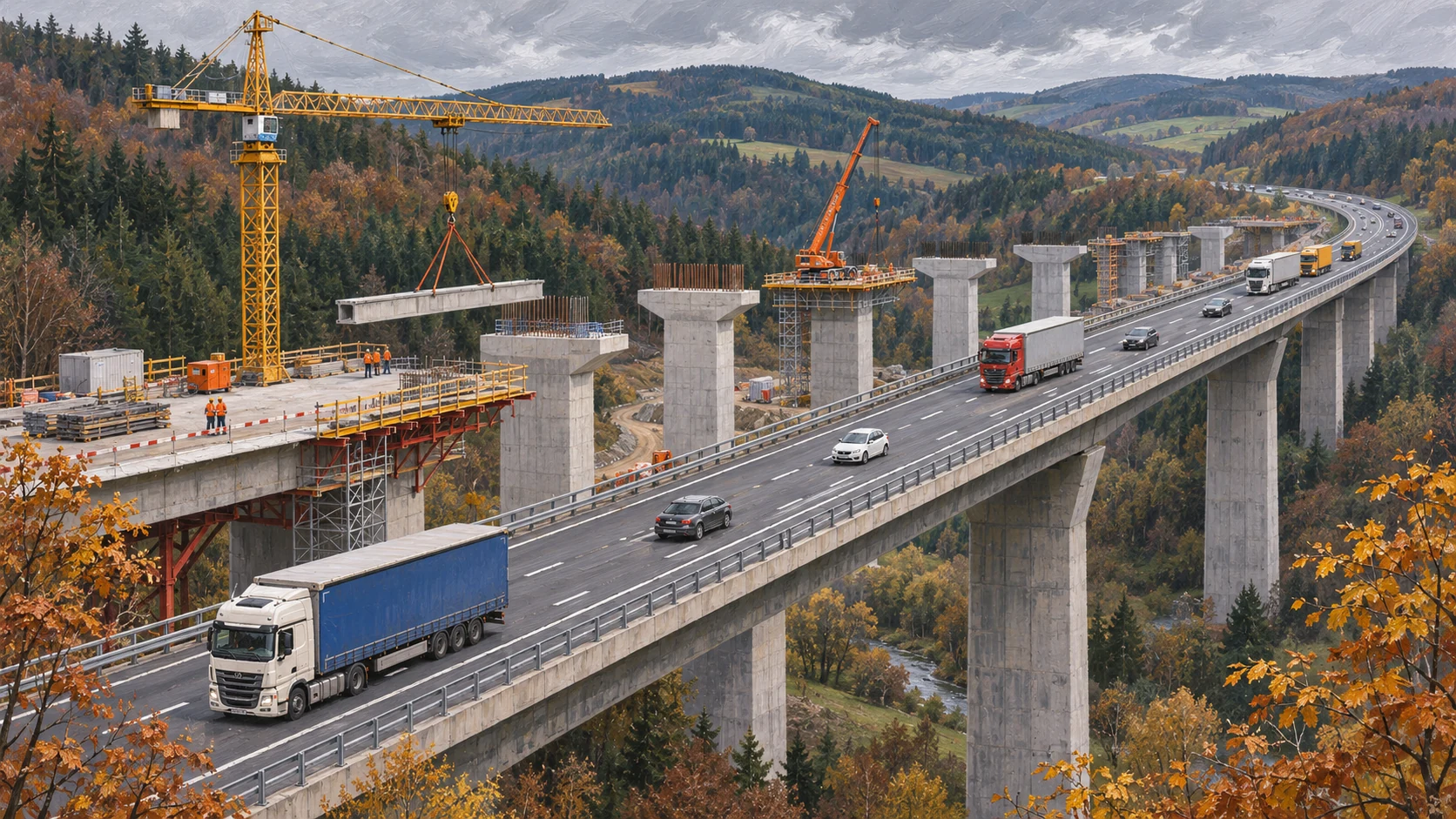
Instead, traffic is often first diverted to an existing half of the bridge. The other half is demolished and replaced. Then traffic switches to the new structure so that the second half can be renewed.
This means additional traffic diversions, partially necessary strengthening of the remaining structure, and significant technical requirements for the construction process.
The completed projects also show that renewal is feasible if planning, approval, and construction are coordinated.
Talbrücke Kattenohl: Why the ground conditions changed the planning
At Hagen, the Talbrücke Kattenohl is being replaced.
In June 2026, the Autobahn GmbH reported on the insertion of the steel structure of the first new partial structure.
The project clearly illustrates problems that are not directly related to the condition of the old bridge.
Difficult ground conditions, steep slopes, and an adjacent high-pressure gas pipeline led to extensive adjustments to the planning.
For the foundations, drilling piles up to 16 meters deep had to be installed in some cases. Excavations were protected with retaining walls over 20 meters high.
Such work cannot be arbitrarily accelerated.
Anyone who only looks at the motorway and asks why the roadworks are not yet finished fails to see a large part of this work at all.
This explains technical delays. However, it does not yet answer why some structures were already known to require renewal long before construction began.
Ottfingen, Büschergrund and Blasbach: The next roadworks are already there.
Further bridge projects will also begin in 2026.
At the Ottfingen valley bridge, the first part of the structure was blown up in July 2026.
Work also began in July on the replacement of the Büschergrund valley bridge between Freudenberg and the Olpe-South motorway junction.
The bridge, built in 1971 and approximately 387 metres long, must be replaced in connection with the planned six-lane expansion.
In Wetzlar, preparations for the replacement construction of the Blasbach viaduct began in October 2026.
To maintain traffic during the construction period, a temporary connecting ramp is to be created there, among other things.
These examples show that the renewal of the Sauerland line is no longer a single construction project.
Numerous measures are currently underway. Others are in preparation.
And every additional construction site must be coordinated with the others in terms of traffic.
The Siegtal viaduct: A huge task still lies ahead
The Siegtal viaduct lies between Siegen and Siegen-Süd.
It was completed in 1976, is around 1,050 meters long and about 100 meters high.
Those standing underneath get an impression of the dimensions the new construction will have.
The Autobahn GmbH describes the renewal itself as one of the greatest technical challenges of the entire A45 expansion.
A cable-stayed bridge is planned, whose largest spans are to reach up to 192.5 meters. Instead of twelve piers, six could suffice in the future.
Traffic is to remain on the motorway during the construction work.
For this, an existing half of the bridge must initially accommodate both directions of traffic, while the other is dismantled.
This sounds at first like a sensible solution.
However, a traffic count in 2015 already registered around 64,000 vehicles daily, including more than 11,000 trucks.
And the traffic load has changed considerably since the 1970s.
In June 2026, the Autobahn GmbH stated to the Siegener Zeitung that the planning approval procedure would not be expected until at the earliest in 2027.
A short-term start of construction is therefore not to be expected.
Given the experiences with the Rahmede viaduct, one can certainly ask what would happen in the event of an unforeseen closure.
However, a complete closure is not announced. It should not be derived solely from the age of the structure.
Nevertheless, the scale of the project clearly shows how important timely planning and sufficient load-bearing capacity of the existing structure until the new construction are.
Which bridges are already finished and which are still under construction?
The official project overview of the Autobahn GmbH lists the following structures.
Already newly built:
Lennetal, Eisern, Rälsbach, Rinsdorf, Marbach, Lützelbach, Haiger, Windelbach, Onsbach, Dorlar, Münchholzhausen and Kalteiche.
Under construction or being implemented:
Kattenohl, Sterbecke, Rahmede, Ottfingen, Büschergrund, Landeskroner Weiher, Sechshelden, Volkersbach, Bechlingen, Bornbach, Blasbach and Heubach.
In addition, numerous structures are being reinforced or have already been reinforced prior to a later replacement.
These include, among others, the valley bridges Ruhrtal, Schlittenbach, Gerlingen, Lüdespert, Kreuzbach and the Siegtalbrücke.
The reinforcements are necessary so that the old structures can continue to withstand the traffic load until their respective replacement. In some cases, they are also intended to allow the entire traffic to be temporarily routed over a single bridge half during the construction work.
The lists mentioned correspond to the published project overview. They are not to be equated with a daily-updated completion report for each individual bridge section.
Why does all of this take so long?
It would be too simple to explain the delays solely with bureaucracy or a lack of political will.
A viaduct reconstruction is a highly complex project.
Numerous questions must be clarified even before the actual construction begins.
The structural integrity: Can an old bridge half carry traffic in both directions during the construction phase? Does it need to be reinforced for that?
The ground conditions: Where can new piers be founded? Are complex bored piles, slope stabilizations, or changes to the planned construction necessary?
The traffic diversion: How are important highway sections prevented from completely failing? What restrictions are unavoidable during demolition?
The approval: Replacement construction is often associated with a six-lane expansion, new road alignments, or extensive interventions in the surroundings. Consequently, the requirements for planning and approval procedures also increase.
In addition, there are environmental and noise protection measures, as well as coordination with railway lines, roads, water bodies, and existing utility lines.
All of this takes time.
However, there is a significant difference between a clearly long construction period and a decision on new construction that has been postponed for years.
The Rahmede viaduct is the clearest example of this.
Here, the decision for new construction was already in place in 2014. Nevertheless, the start was postponed multiple times until the old bridge had to be completely closed in 2021.
Gambacher Crossing: No roadworks yet, but already fewer truck parking spaces
The fact that the problems on the A45 are not limited to dilapidated bridges is also shown at the Gambacher Crossing.
There, the motorway is to be expanded to six lanes. However, while the actual construction work in this area has not yet begun, the two truck parking spaces Pfahlgraben and Hardt-Wald have already been closed since July 6, 2025.
Around 16 truck parking spaces have thus been lost.
In response to my press inquiry, the Autobahn GmbH explained that the parking areas have significant structural defects and that renovation is not economically viable in view of the planned motorway expansion.
This may be understandable from the perspective of construction planning. However, for professional drivers, it does not change the fact that they are already lacking parking options today, even though nothing of the actual construction work is visible yet.
And this on a motorway where suitable truck parking spaces are already scarce anyway.
Here another problem of long-term infrastructure planning becomes apparent: while bridges wait for their replacement for years and expansion projects are repeatedly delayed, the restrictions for road users often arise long before the first spade stroke.
In detail, I have already dealt with the two closed parking spaces in a separate article and also published the statement from the Autobahn GmbH there.
Was too long waited?
It would be wrong to claim that nothing happened at all on the A45 for decades.
Bridges were regularly inspected, damages repaired, structures reinforced, and entire structures replaced.
The question is rather whether the scope and speed of these works matched the foreseeable aging of the infrastructure.
As early as January 2014, there was a comprehensive concept for the renewal of the viaducts along the A45 in North Rhine-Westphalia.
Thus, the problem was not only known since the closure of the Rahmede viaduct.
And exactly here lies the crucial point.
If numerous bridges are built within a few years, they also reach a similar age within a comparatively short period of time.
That a substantial need for renewal will eventually arise from this is foreseeable.
However, not every bridge can be replaced as early as desired. After all, public funds must be used responsibly, and a bridge with sufficient load-bearing capacity does not have to be demolished solely because of its age.
But just as little can the replacement of numerous structures be postponed indefinitely.
The difficulties arise at the latest when many major projects become urgent simultaneously.
What does this mean for freight transport?
For professional drivers, the A45 has been associated with restrictions for years.
Narrowed lanes, speed limits of 60 at individual bridges, roadworks, and no-overtaking bans determine everyday life in many places.
Furthermore, the route cannot be used for heavy goods transport over 44 tonnes in large parts.
When individual motorway sections have to be closed, this affects not only the drivers themselves.
Traffic is diverted to other motorways and roads that are often not designed for these additional volumes.
People in the Lüdenscheid area experienced this directly during the multi-year Rahmede closure.
A functioning motorway is not just a connection between two service areas. It is also part of the economic infrastructure of an entire region.
What we should learn from the A45
The Sauerland line is a case study of what happens when many large infrastructure projects become necessary simultaneously.
There are examples of rapid new constructions. There are technically difficult construction sites whose duration is understandable. And there are cases where the documented history raises uncomfortable questions.
Above all, Rahmede shows that a postponement on paper can eventually have very real consequences.
The Autobahn GmbH is currently working on numerous bridges at the same time. This is necessary and deserves recognition given the technical challenges.
However, the number of parallel construction sites also raises the question of why the renewal could not be organized earlier and more evenly.
For the A45 is not only a few years older. Many of its bridges have been standing for more than half a century.
And if you are traveling on the Sauerland line today, you get an impression of the effort it takes to fundamentally renew such infrastructure over decades under live traffic.
Not every construction site is a sign of poor planning. But the history of some bridges shows what consequences it can have to keep postponing necessary renewals into the future.
Und solche Folgen gibt es nicht nur beim Brückenbau, wie man in meinem Artikel über die Straßenschäden und Tempo 30 wegen Lärmschutz lesen kann.
Quellen und weiterführende Informationen
- Autobahn GmbH: Gesamtausbau der A45 zwischen Dortmund und Gießen
- Autobahn GmbH: Talbrücke Rahmede
- Landtag NRW: Bericht zur Rahmedetalbrücke und ihrer Vorgeschichte
- Bundestag: Drucksache 20/833 zur Verschiebung des Rahmede-Neubaus
- Autobahn GmbH: Replacement construction of Sechshelden
- Autobahn GmbH: Wetzlar Interchange and Engelsbach Viaduct
- Autobahn GmbH: Replacement construction of Siegtal Viaduct
- Autobahn GmbH: Completion of Eisern, Rinsdorf and Rälsbach
- Landtag NRW: Overall concept A45, planning status 2014